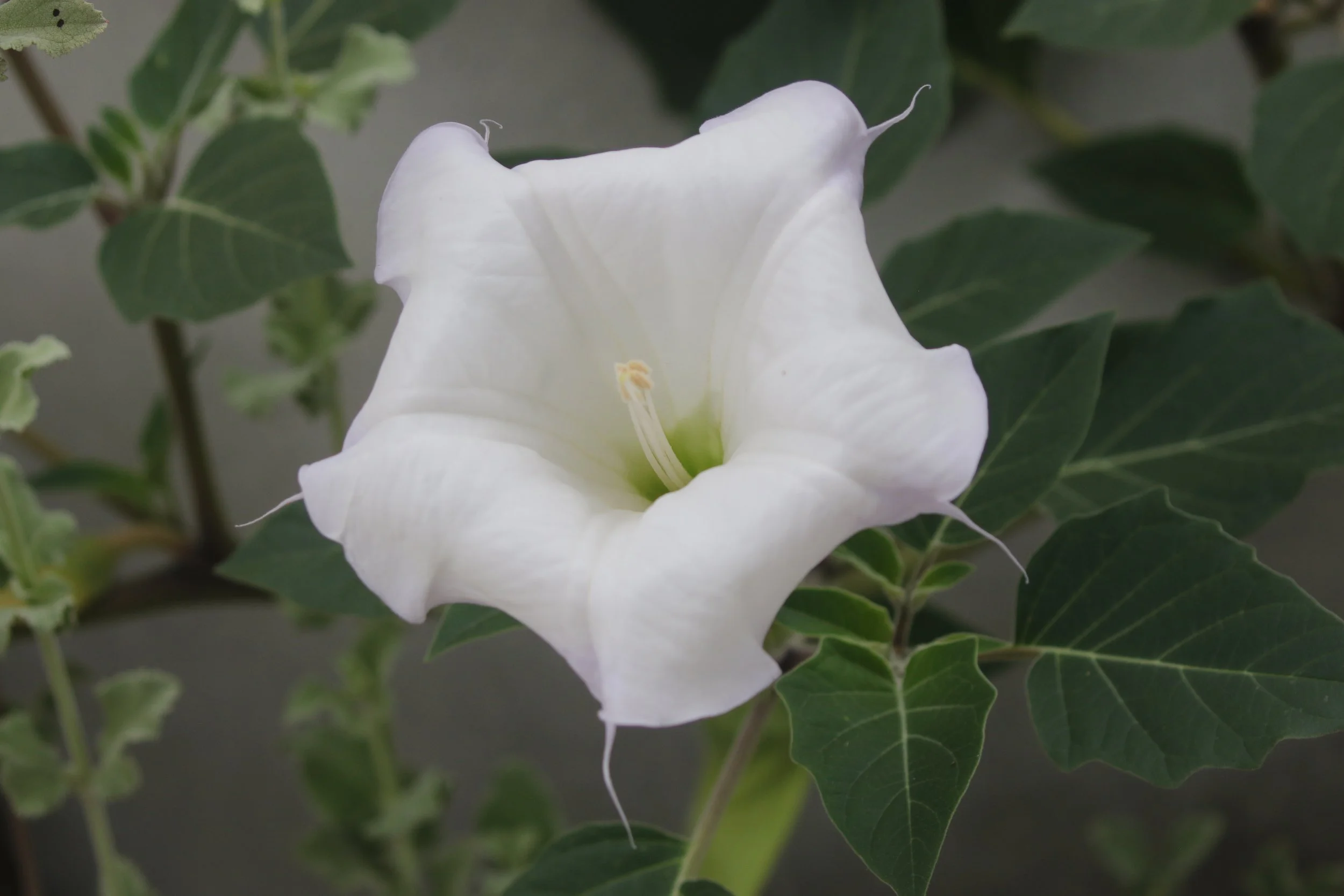
The Night’s Architecture: A Study of California’s Sacred Datura
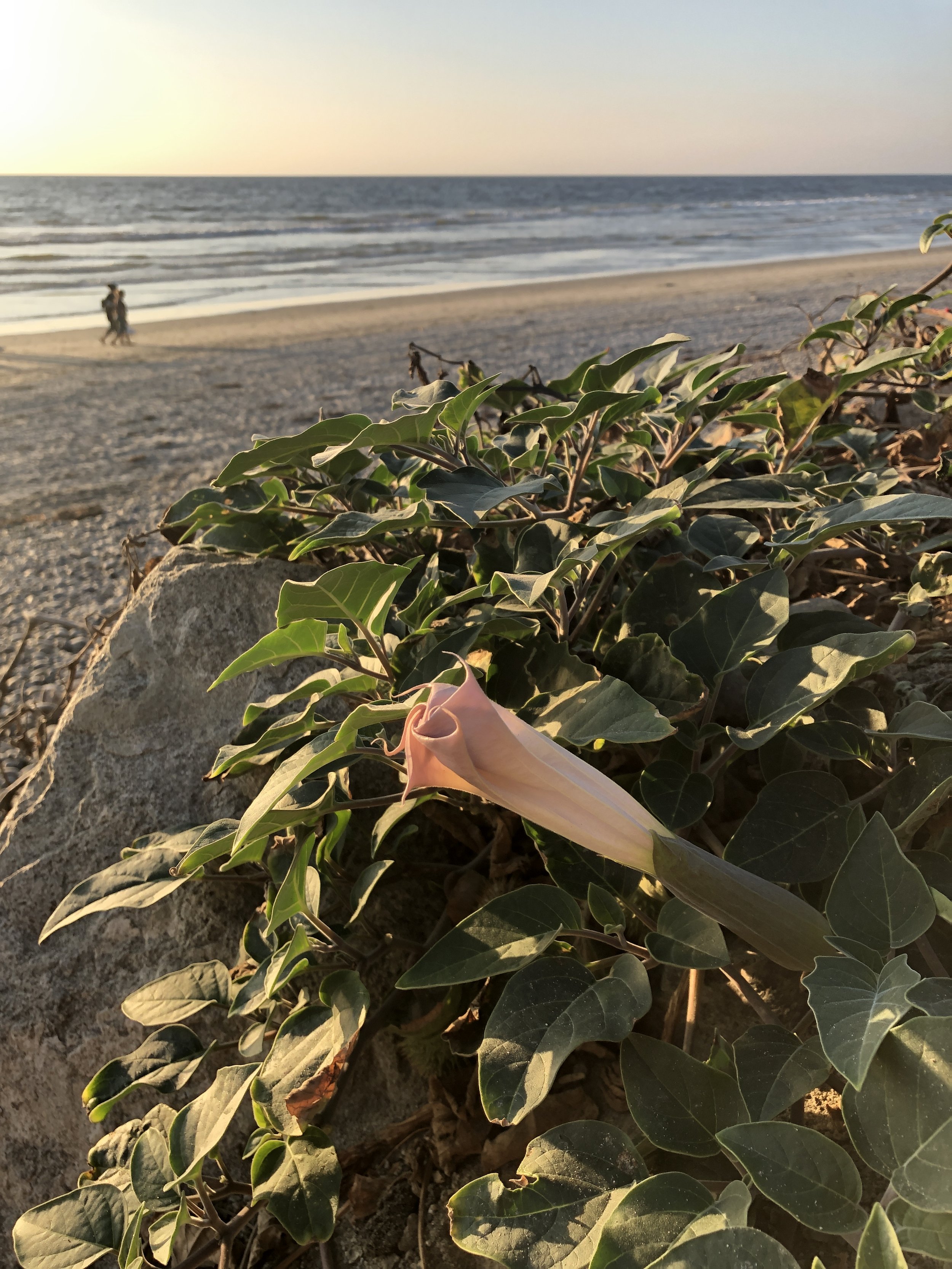
In the high heat of a California afternoon, Datura wrightii looks like a secret hidden in plain sight. Its low-slung, velvety gray foliage hugs the disturbed soil of roadsides and desert washes, appearing almost muted against the vibrant glare of the sun. But as the light fades and the temperature drops, the plant undergoes a structural transformation.
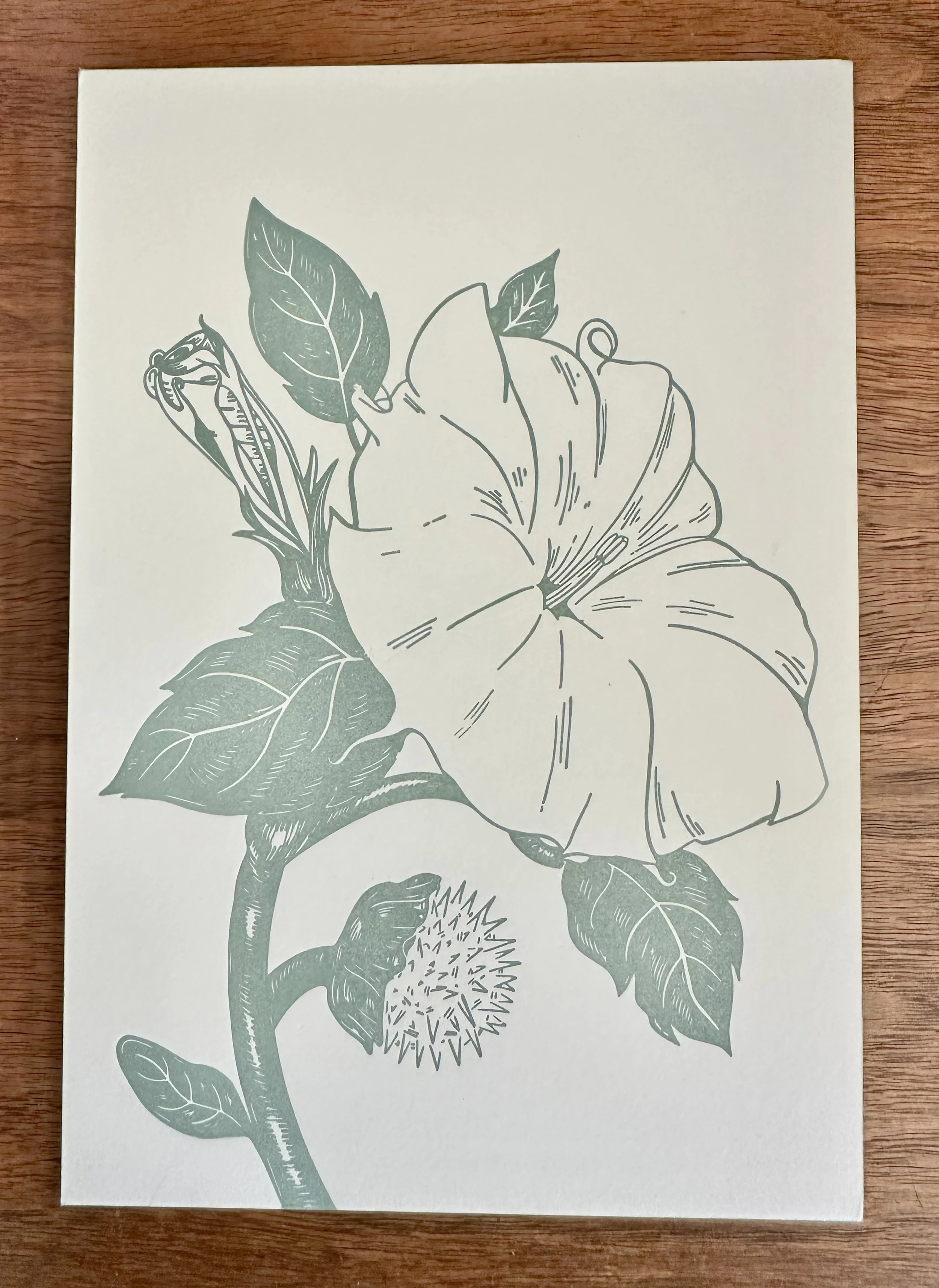
For our Kale Tree® studio, Datura is more than a botanical curiosity; it is a masterclass in organic geometry. We’ve long been drawn to its vespertine nature, the way its massive, pleated buds unfurl with mechanical precision at dusk. What began as a single illustration for a holiday card has become a permanent fixture in our creative vocabulary. We return to its silvered leaves and trumpet-shaped silhouettes not just for their beauty, but for their resilience. In this study, we look past the plant's reputation to explore its role as a cornerstone of the nocturnal ecosystem and a primary muse.
Nocturnal Synchronicity: The Hawkmoth and the Bloom
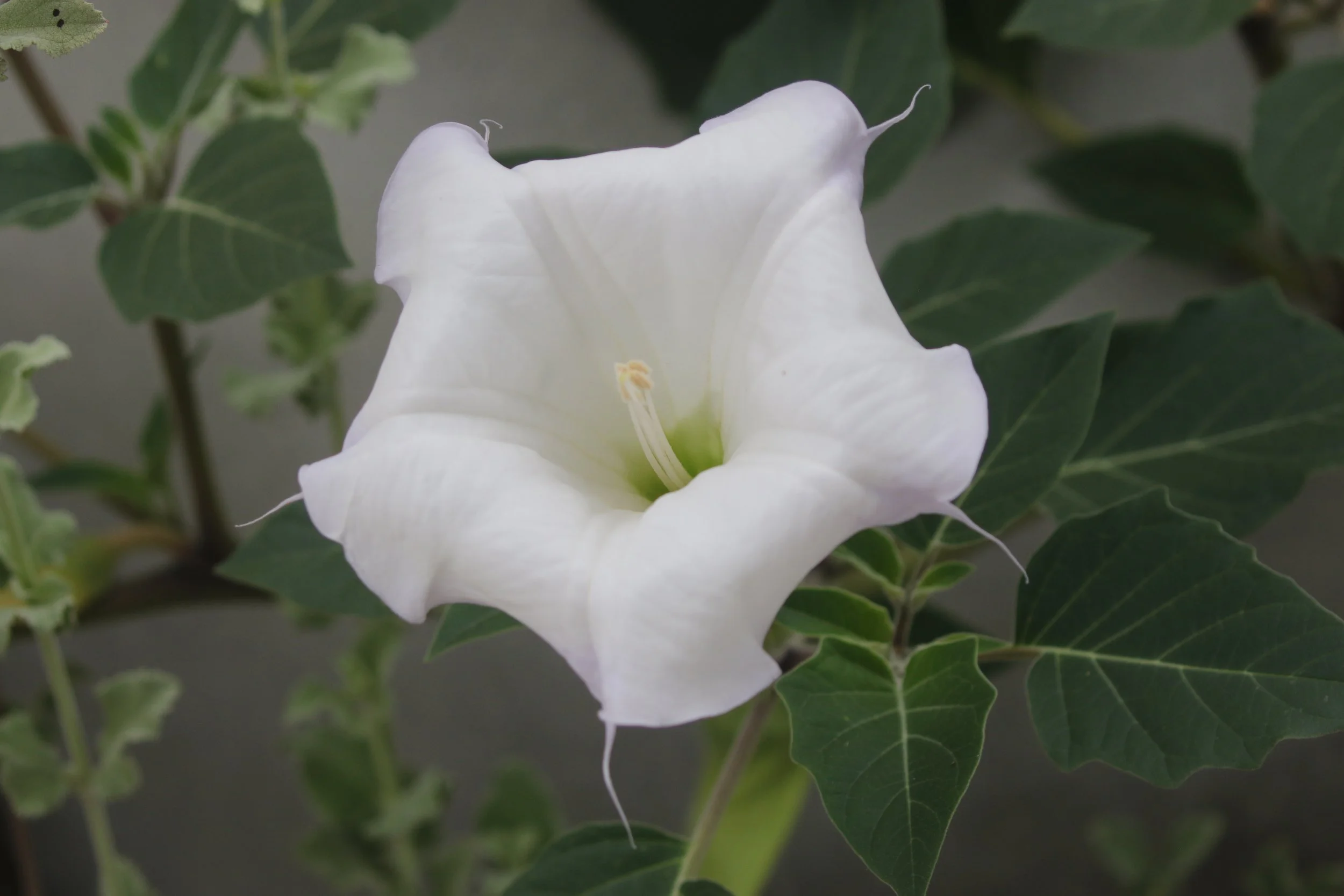
While much of the California landscape thrives under the sun, Datura wrightii operates on a different clock. As the heat of the day dissipates, the plant begins a coordinated sensory display. The massive white trumpets don't just open, they exhale. They release a heavy, intoxicating fragrance that serves as a GPS signal for the Sphinx Moth, or Hawkmoth (USDA Forest Service).
The relationship between the two is a marvel of biological engineering. To reach the nectar deep within the flower’s throat, the Hawkmoth unfurls a proboscis that matches the flower's depth almost perfectly. As the moth hovers, steady as a hummingbird, it becomes an accidental messenger, brushed with the pollen that will sustain the next generation of Datura. In the quiet of a desert or coastal evening, this interaction is one of the few movements in an otherwise still landscape, a silver-on-silver dance that has become a foundational reference for our studio's tonal palettes.
The Ephemeral Bloom
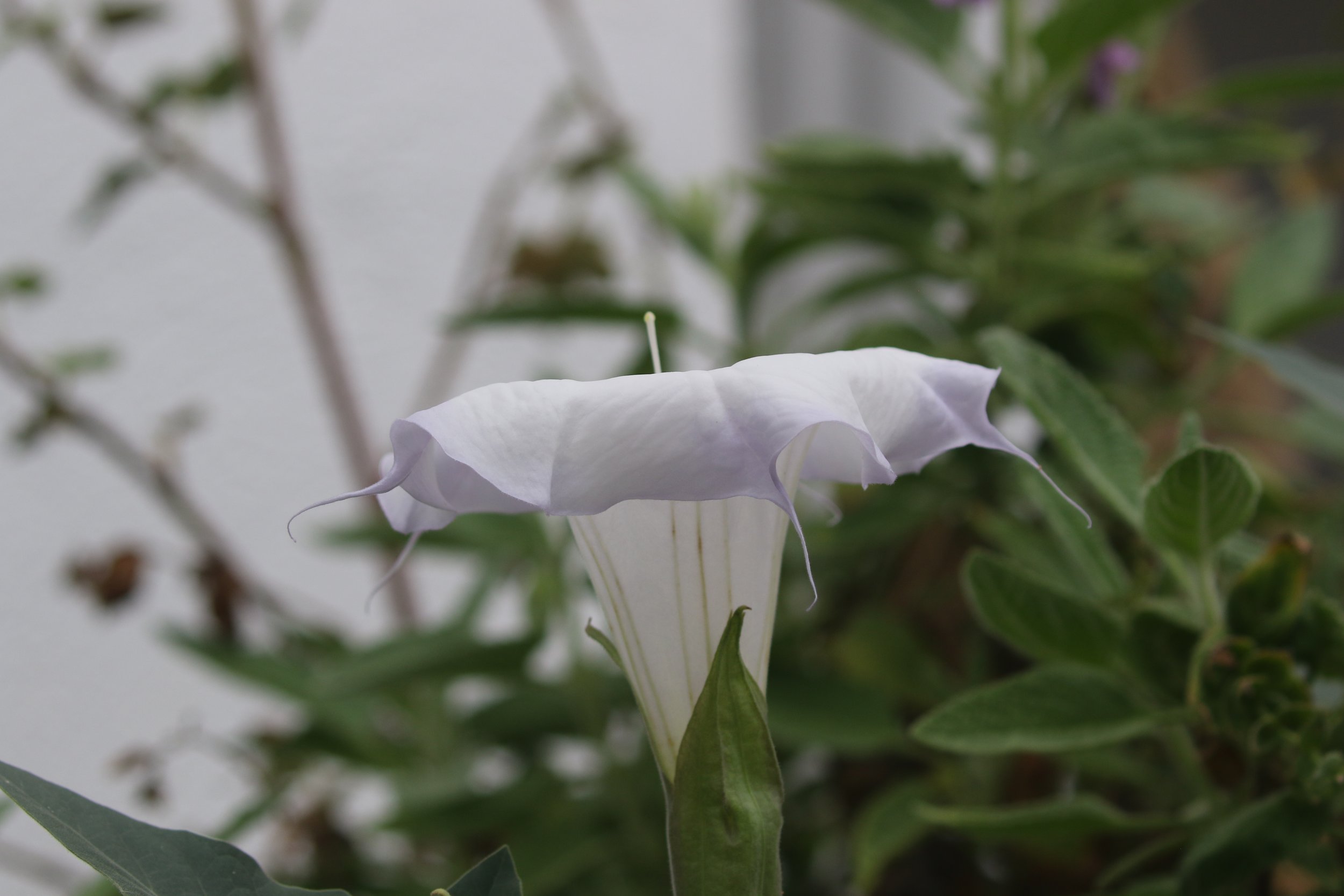
There is a quiet dignity in the plant’s timing. Each flower is a singular event, opening at sunset and offering its full splendor to the night. By the time the next morning’s sun reaches its peak, the bloom has already begun to retreat. This brief, intense window of beauty ensures the plant’s energy is focused on its nocturnal partners, creating a potent moment of connection that defines the rhythm of the desert night.
Deep Roots: A Legacy of Respect
In California, you cannot discuss Datura without acknowledging its profound cultural significance. For the Chumash and Tongva peoples, the plant, known as Momoy or Manit, is far more than a roadside wildflower. It is a sacred entity, historically integrated into rites of passage and sophisticated medicinal practices (Timbrook, 2007).
This history informs how we view the plant today. It isn't just ornamental; it carries a gravity that demands reverence. It is both beautiful and dangerous, as all parts of the plant are highly toxic if ingested (UC IPM). By respecting its boundaries, we can appreciate its role as a survivor. It thrives where other plants wither, providing a critical nectar source in arid environments and standing as a living link to California’s deep botanical and cultural history.
A Note for the Native Garden: The Rowntree Perspective
The pioneer horticulturist Lester Rowntree often spoke of the necessity of bringing the wild into the garden, provided we respect the plant's true nature (Rowntree, 1939). Of the Sacred Datura, she noted its paradoxical beauty and its ability to look lush and tropical while requiring almost nothing from the gardener.
To introduce this architectural giant into the landscape, there are a few considerations. In the wild, Datura wrightii can spread up to 15 feet. In a garden, it needs room to breathe and expand. It craves full sun and well-draining soil. It is drought-tolerant, often performing better with neglect than with over-care. Do not be alarmed if the plant disappears in winter; it is a perennial that retreats into its hardy root system, waiting for the warmth of spring to push it back through the soil. Finally, because of its high toxicity, it should be planted with care, taking into account its proximity to children and pets.
A Continuous Muse
Our work at the studio is an ongoing dialogue with plants like these, species that refuse to be ignored and offer a structural complexity we find endlessly inspiring. The Sacred Datura reminds us that the most profound beauty often reveals itself only when we are willing to wait for the sun to go down.
Works Cited
Rowntree, Lester. Hardy Californians. Macmillan, 1939.
Timbrook, Jan. Chumash Ethnobotany: Plant Knowledge Among the Chumash People of Southern California. Santa Barbara Museum of Natural History, 2007.
UC IPM. "Sacred Datura." University of California Statewide Integrated Pest Management Program.
USDA Forest Service. "Datura wrightii (Sacred Datura)." U.S. Forest Service Celebrating Wildflowers.
LA Textile: Organic, Sustainable and Recycled Fiber Fabrics

The Kale Tree design team had a great time visiting LA Textile at the California Market Center. We set out to meet the best new designers, manufacturers, mills, and printers in the heart of downtown Los Angeles and are excited about the new friends and connections we've made.

Organic textiles were at the top of our sourcing list. We're happy to report that there were an increasing number of suppliers with organic fabrics in varying weights and colors on the showroom floor. While natural and organic textiles were displayed from across the globe, we found a strong presence of Japanese mills with elegant certified organic cotton twills, batiste, canvas, and satin weaves.

We also connected with the folks at Cotton Incorporated and had an interesting chat about U.S. Cotton and the importance of traceability and transparency in cotton fiber textiles.

Recycled fiber textiles are another fabric we are especially interested in designing in our studio. While luxury-level recycled fiber textiles are still somewhat in limited offerings, we were pleased to connect with mills offering recycled polyesters, textiles made from recycled water bottles, and Seaqual fabrics made from recycled ocean plastics. We love to see mills working with recycled fiber yarns and especially support efforts to remove plastics from the ocean.

Custom-printed textiles are at the heart of what we do. We love fabric, and we find it incredibly rewarding to see our nature-inspired illustrations realized as drapery, bedding, pillows, and a host of other home decor items. At the LA Textile event, we were delighted to connect with like-minded folk who care about sustainability and wellness in design, sourcing, and production methods.

The Kale Tree design team is working on a new organic textile collection for 2023 featuring California native flora and fauna. Inspired by the local wildlife of our Southern California mountains, deserts, woodlands, and beaches, we look forward to sharing more with you soon!
Night Shift Pollinating: the Magic of Moths
Nature enthusiasts and scientists alike are well aware that pollination is crucial for environmental well-being. Insects such as bees and butterflies have experienced a well-deserved moment in the spotlight for being the primary sources of pollination for our environment. However, this could be a case of accidental bias on our part. New research has found that multiple species of magnificent yet harshly misunderstood moths are hard at work while we are asleep, picking up the pollination shift where bees, butterflies, and other daytime pollinators left off.

Megalograpga moth. Identified by inaturalist.org. Photo by Sarah Barnard.
Historically, moths and other nocturnal pollinating insects have not been included in mainstream research. Because of this accidental oversight, we knew very little about the extensive pollination efforts of these mysterious nocturnal creatures. However, new research on nocturnal pollination has allowed us to turn our attention and appreciation towards the moth, a beautiful and diverse insect species that we now know is part of the pollination team. The Royal Society conducted a study in which they swabbed pollen from 883 moths. The scientists found that 381 moths out of their sample contained pollen from more than one plant species on their fuzzy underbellies. These results suggest that moths visit and pollinate multiple plants at night and are highly influential in wild plant pollination. Moths pollinate some of the same plants visited by bees and other daytime pollinators. This new research shows that bees, butterflies, and moths work in a holistic combined effort towards pollination and environmental wellness.

Snout Moth. Identified by inaturalist.org. Photo by Sarah Barnard.
Moths tend to pollinate flowers with strong, sweet smells emitted at night. They are especially attracted to flowers that produce ample nectar that is easy to access through long, tubular flowers. They are most attracted to flowers with pale white and dull red colors, hues of pink and purple, and large petals with clusters.
The responsibility of pollinating our planet falls on the shoulders of many species, as well as Earth's natural elements of wind and water. Protecting our planet's natural pollinators improves the health of our ecosystem and, in turn, improves our well-being. Pollinators are not only crucial to our environment, but they are also incredibly essential for human life and function. The United States Environmental Protection Agency states, "pollinators provide humans with one in every three bites of food we eat, cotton to make clothing and other items we depend on, and habitats and food for countless other animals.
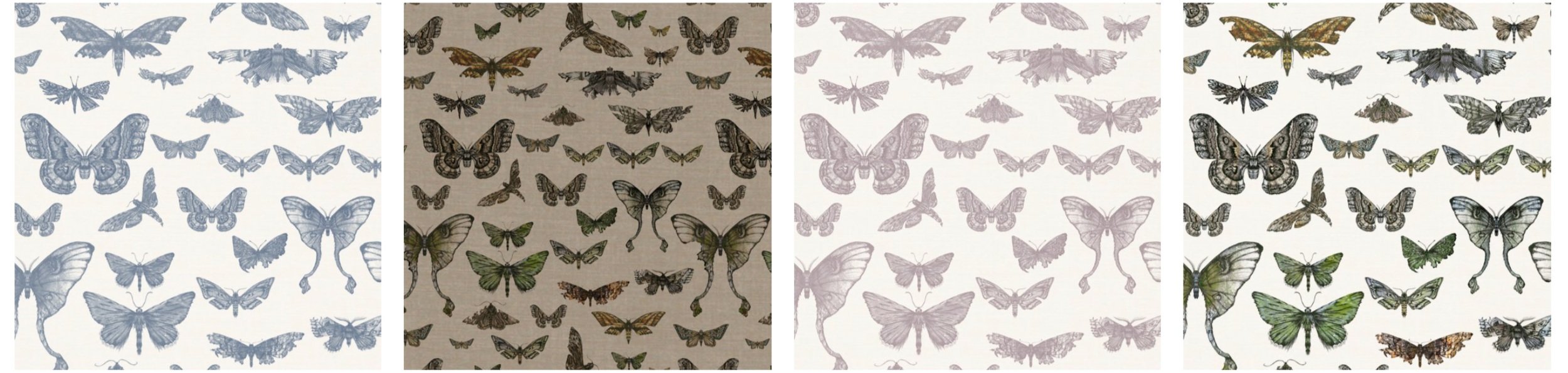
Entomology Moth Drawer by Tradescant & Son depicts tattered and delicate hand drawn moths, some showing their age to create a raw and honest depiction.
As we learn more about moths and their vital role in the holistic pollination of our planet, we become better equipped to protect them and Earth's pollination systems as a whole. There are many steps you can take to help protect moths and promote pollinator well-being:

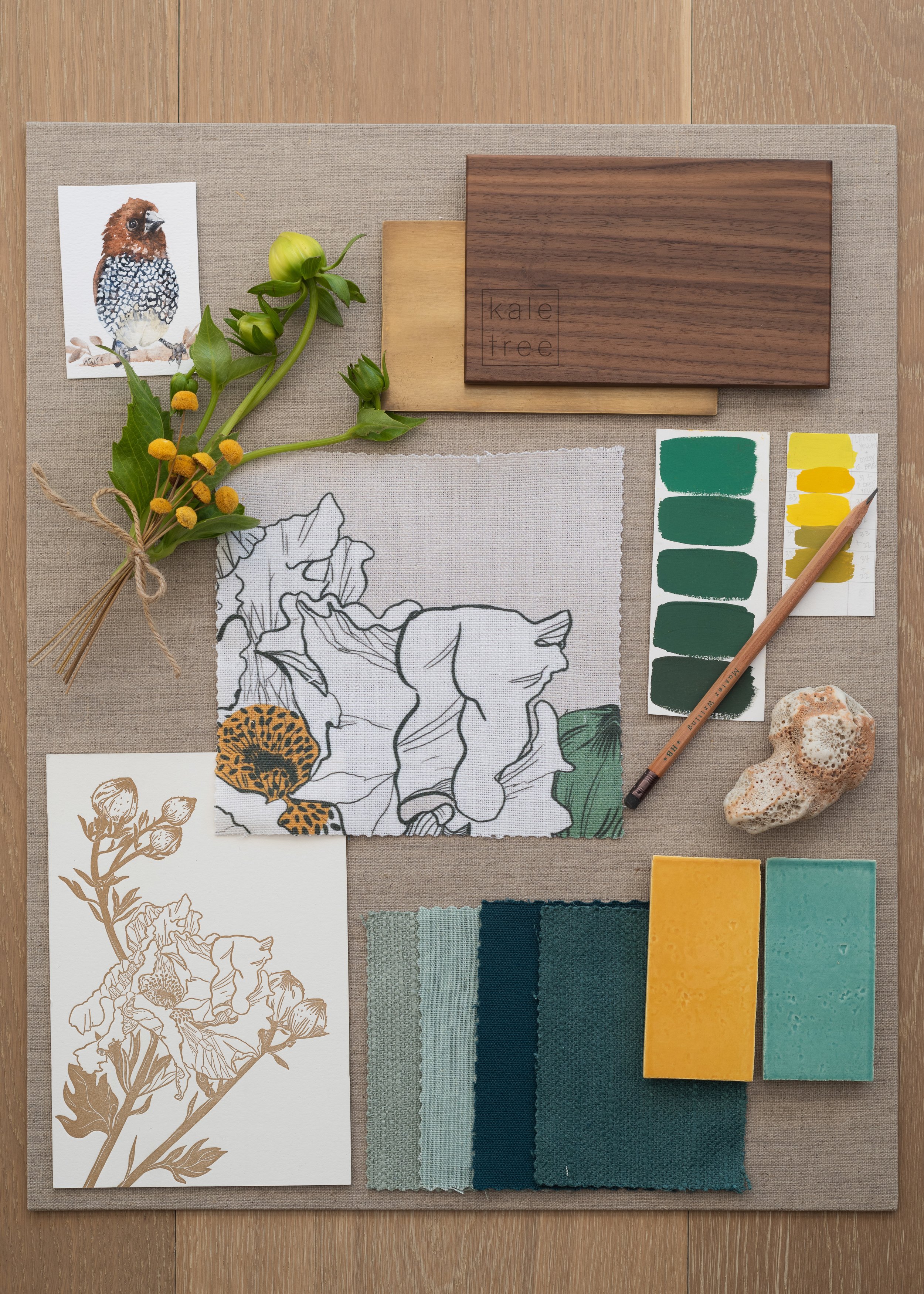
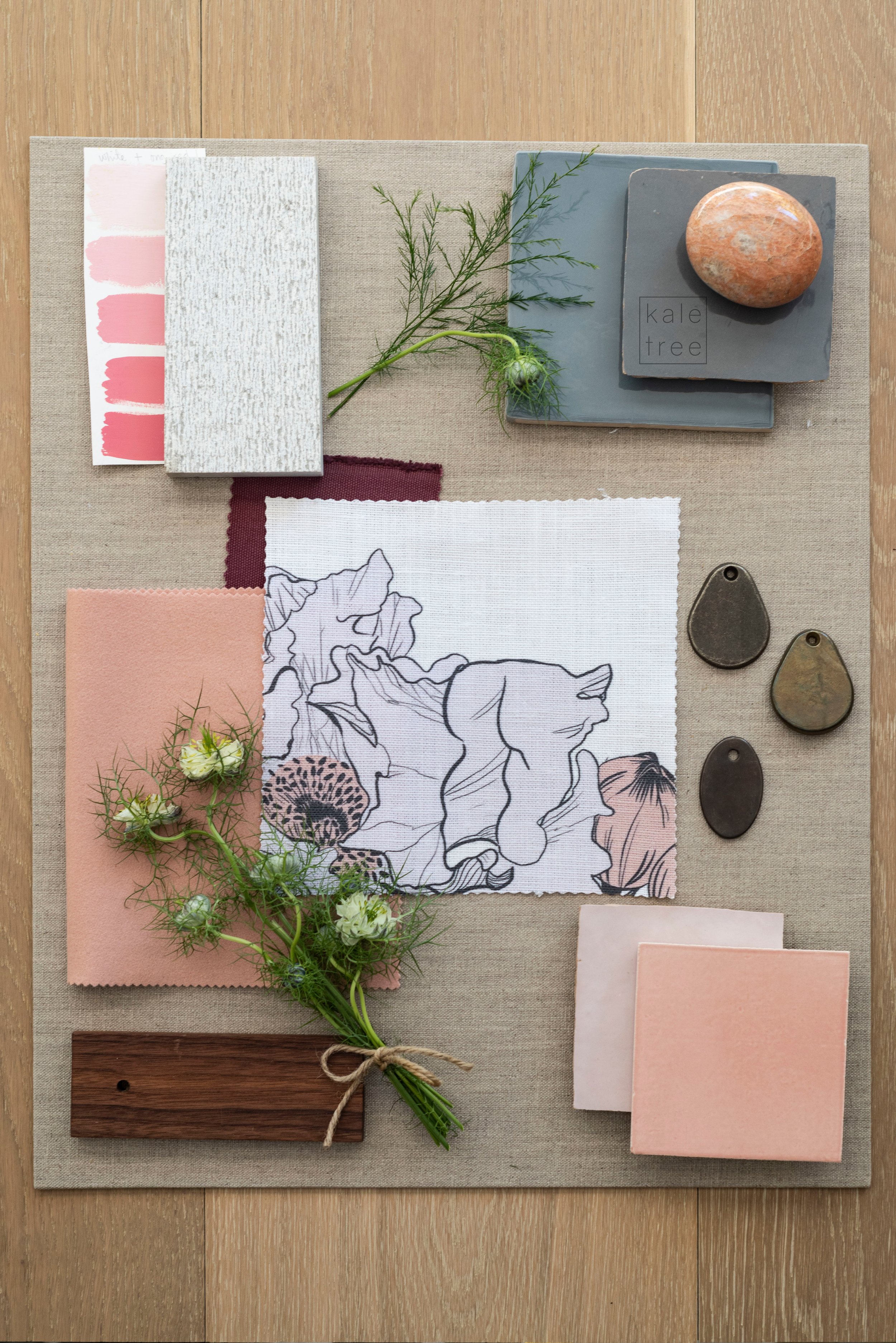
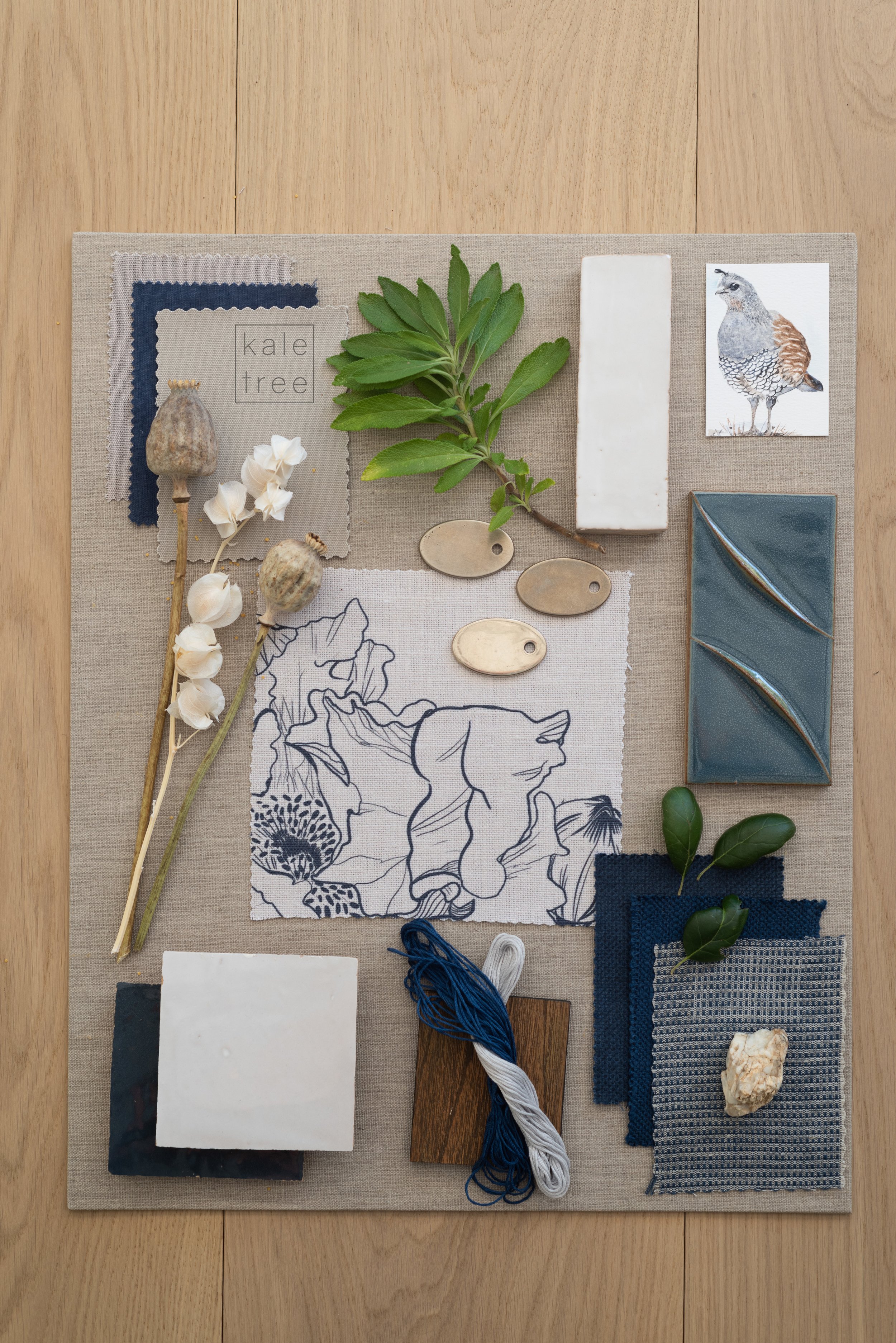
Moth textile by Kale Tree celebrates the beauty of moths in a 100% linen fabric.
While most pollination-protecting efforts can help the wide variety of pollinating species, one hazard unique to pollinating moths is light pollution. Avoid the use of lighting in your garden as artificial lights can disorient moths, impairing their abilities to find mates, protect themselves from predators, and find flowers to pollinate.
Plant moth-approved flowers in your garden that bloom in a variety of seasons
Plant in "clusters" so that your nighttime pollinating visitors can easily access flowers to pollinate in your garden
Eliminate the use of pesticides and herbicides.

Kale Tree Studio gathers much inspiration from the natural scenery around us to create our products, and as such, our products are made with a commitment to sustainability and environmental wellness. For example, our moth rug is inspired by the neutral creams and toasted grey hues of a moth's wing, available in Bamboo Silk or 100% New Zealand Wool. As a studio with a mission to promote health and well-being, Kale Tree cares deeply about protecting all of Earth's natural pollinators. With newly available research, we can help moths achieve their much-deserved spotlight on the pollination stage, along with their daytime pollinating friends.

Damaged Lace by Tradescant and Son was inspired by the ethereal beauty of pre-loved antique lace combined with the raw honesty of the destruction of lace eating moths.
Resources
CNN Health. “Moths play a vital role in pollinating flowers and plants, new research suggests.”
The Royal Society Publishing. “Nocturnal pollinators strongly contribute to pollen transport of wild flowers in an agricultural landscape.”
U.S. Forest Service. “Pollinator Syndromes.”
Xerces Society. “The Night Shift: Moths As Nocturnal Pollinators.”
United States Environmental Protection Agency. “Protecting Pollinators.”
Pollinator Partnership. “About Pesticides.”

Nature at Home: Botanical Textiles from Tradescant & Son Now Available at Kale Tree Shop
Sarah Barnard is now the exclusive California representative for Tradescant & Son through Kale Tree Shop's online marketplace. The line features a wide range of nature-inspired luxury eco fabrics and wallpapers made with a sustainability-minded production process.

Sarah Barnard is now the exclusive California representative for Tradescant & Son through Kale Tree Shop's online marketplace. The line features a wide range of nature-inspired luxury eco fabrics and wallpapers made with a sustainability-minded production process.
The foundation of Sarah Barnard's practice is a belief that interior environments should contribute to wellbeing, both emotionally and globally. Barnard's work focuses on sustainability, emphasizing the importance of nature, both through conscious sourcing and as the inspiration for many of her designs.
The designer's use of natural themes and environmentally conscious materials spoke to the sensibilities and priorities of Tradescant & Son, who recognized Barnard as an ideal representative for their line. Tradescant & Son director Amy Hardman says, "Our 100% linens and the relaxed yet stylish look to our designs promote a holistic and contemporary feel. This, together with the fact that we share a commitment to ensuring sustainability wherever possible by using locally woven fabrics and printers, is a fantastic and exciting foundation for our relationship with Sarah Barnard Design."

The fabrics and wallpapers feature a wide variety of natural themes, from a graphic striped wallpaper composed of vibrant hummingbirds to linen textiles inspired by historic entomology archives from the University of Oxford Museum of Natural History, softly patterned with moths or beetles. With a range of bird fabrics, butterfly patterns, and botanical prints, the timeless patterns nod to historical, scientific illustrations, while their colors and design have a contemporary feel suitable for a diverse array of settings.
On the collaboration, Barnard noted that "As a birder, naturalist, and avid gardener, I was drawn to Tradescant & Son's collection of biophilic prints. Particularly when designing for metropolitan areas, I like to turn to natural motifs to stand in for nature that may not be as readily available for someone with a city view. The entire Tradescant & Son collection offers an impressive array of options when looking to bring the experience of wildlife into an interior."
These products are available for purchase through the website www.kaletree.com. Additional support is available for design and trade professionals by contacting shop@kaletree.com.

Sarah Barnard is a WELL and LEED accredited designer and creator of environments that support mental, physical and emotional wellbeing. She creates highly personalized, restorative spaces that are deeply connected to art and the preservation of the environment. An advocate for consciousness, inclusivity, and compassion in the creative process, Sarah's work has been recognized by Architectural Digest, Elle Décor, Real Simple, HGTV and many other publications. In 2017 Sarah was recognized as a "Ones to Watch" Scholar by the American Society of Interior Designers (ASID).