Crow Inspired Interior Design
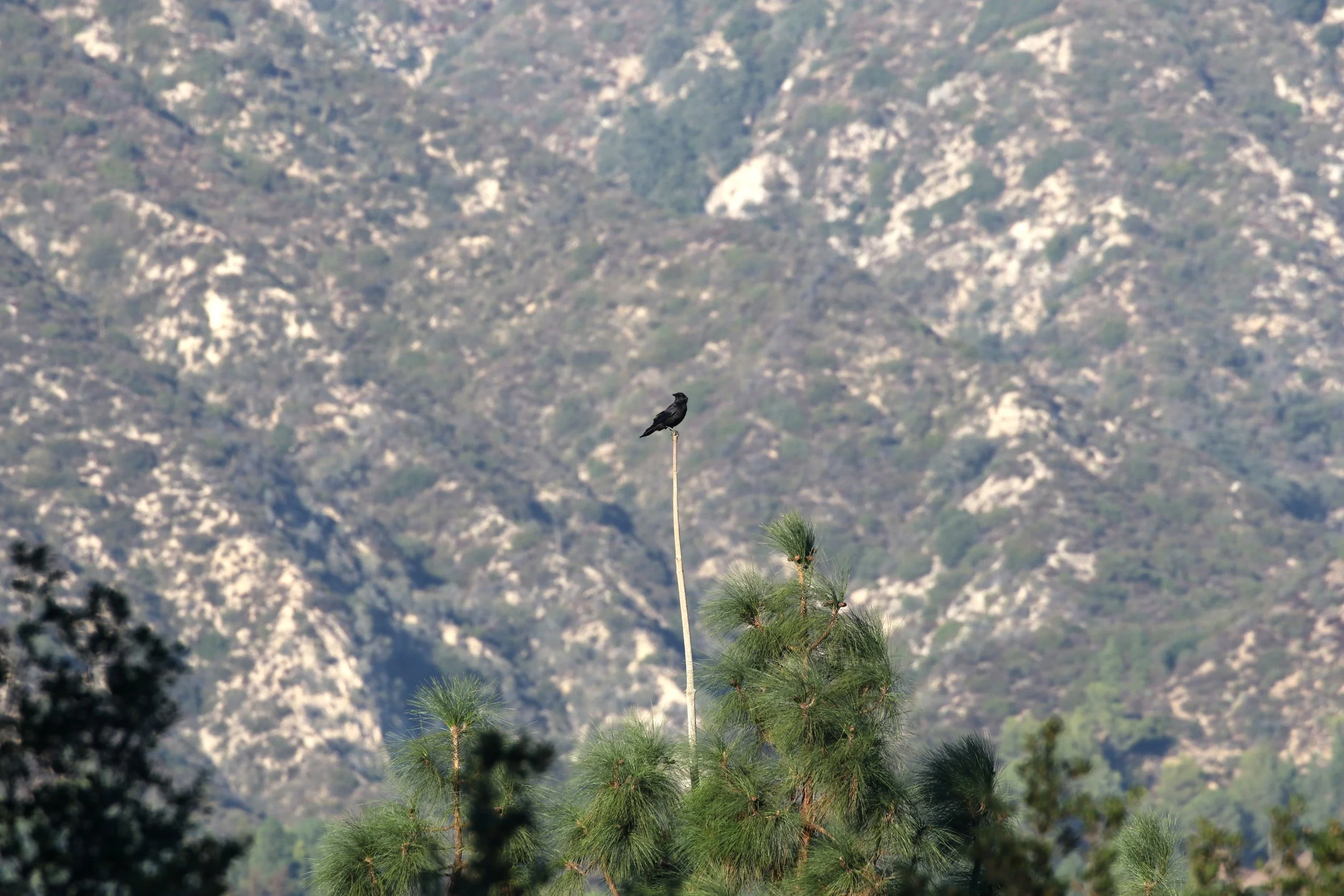
Nature supplies us with endless inspiration for interior design, and a cast of characters with beauty and personality that adds special nuance, especially when considering the bird kingdom. In particular, the crow has an interesting backstory that adds depth to its role as a muse for interior design.
The crow is an often misunderstood bird. It’s mysterious, quietly and intensely intelligent (some experts say it’s as smart as a seven-year-old child, and is the subject of many duplicitous symbols: it can represent doom and gloom, but also new beginnings and hope, depending on the cultural context. It’s also viewed as a trickster, in part because its high intelligence helps it outsmart foes. Even their coloring is varied, depending on light conditions.
All About Crows
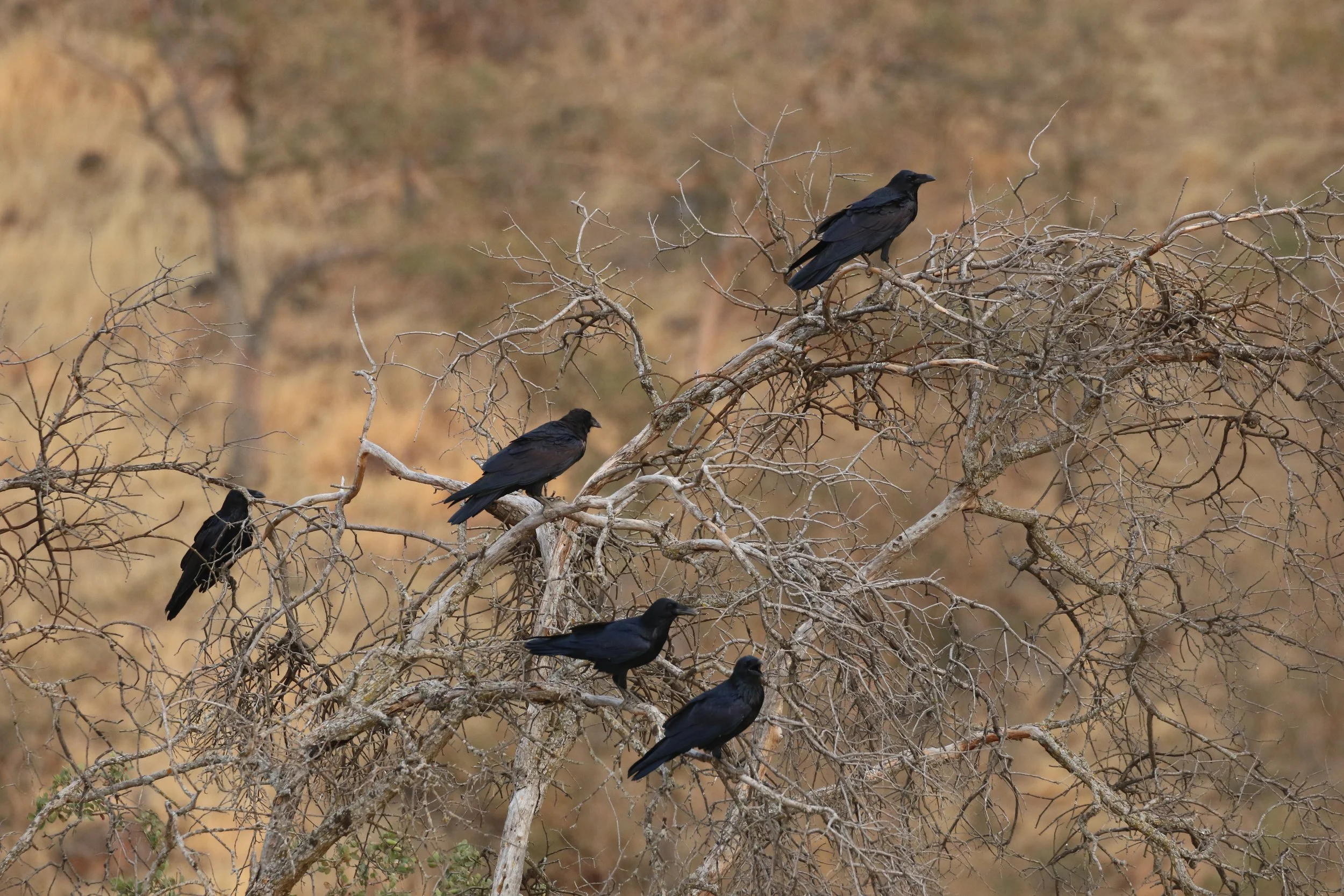
Crows have a kind of gothic, ethereal look, with all-black feathers, legs, and beak. At a closer look, though, the crow’s feathers reveal iridescent coloring, with shades of purple, blues, green, and more. Rather than being a true black, light plays across their feathers, casting an almost metallic sheen.
Their eyes are a steely blue, and baby crows have pink coloring around their mouths, called a gape, which helps parents identify them, aids feeding, and marks them as youngsters to other crows.
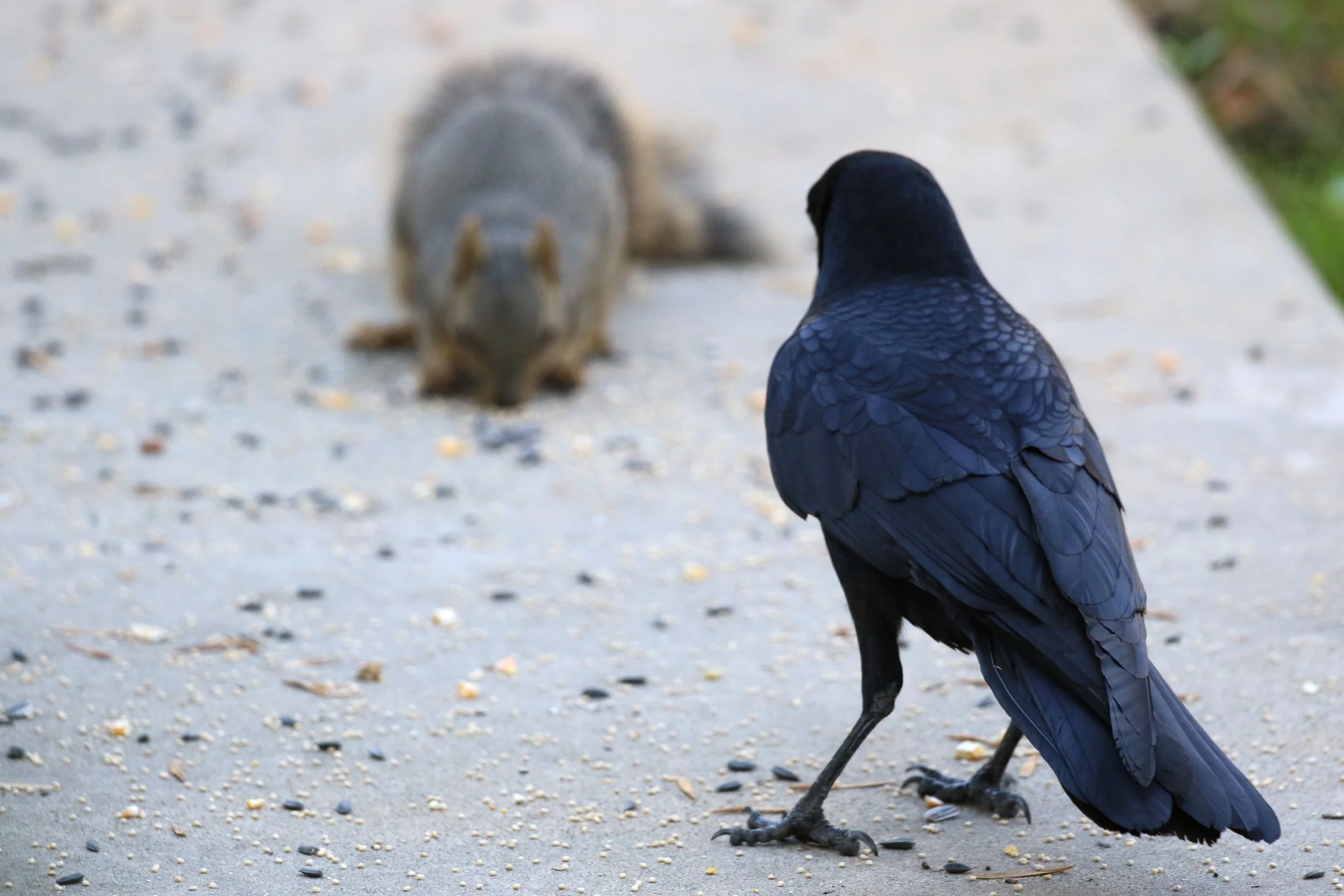
Behaviourally, crows are known for mobbing, where gangs of the birds gather together and dive-bomb and squawk at perceived predators. They might be protecting a nest or territory. This is often effective against larger predators, who often give up and leave, simply because of the number and frenetic behavior of the crows- it’s not worth the predator’s time.
The most common species of crow in the United States is aptly named the American Crow. They are highly communal, often gathering in large roosts of upwards of 100 birds to sleep together for warmth on cold nights.
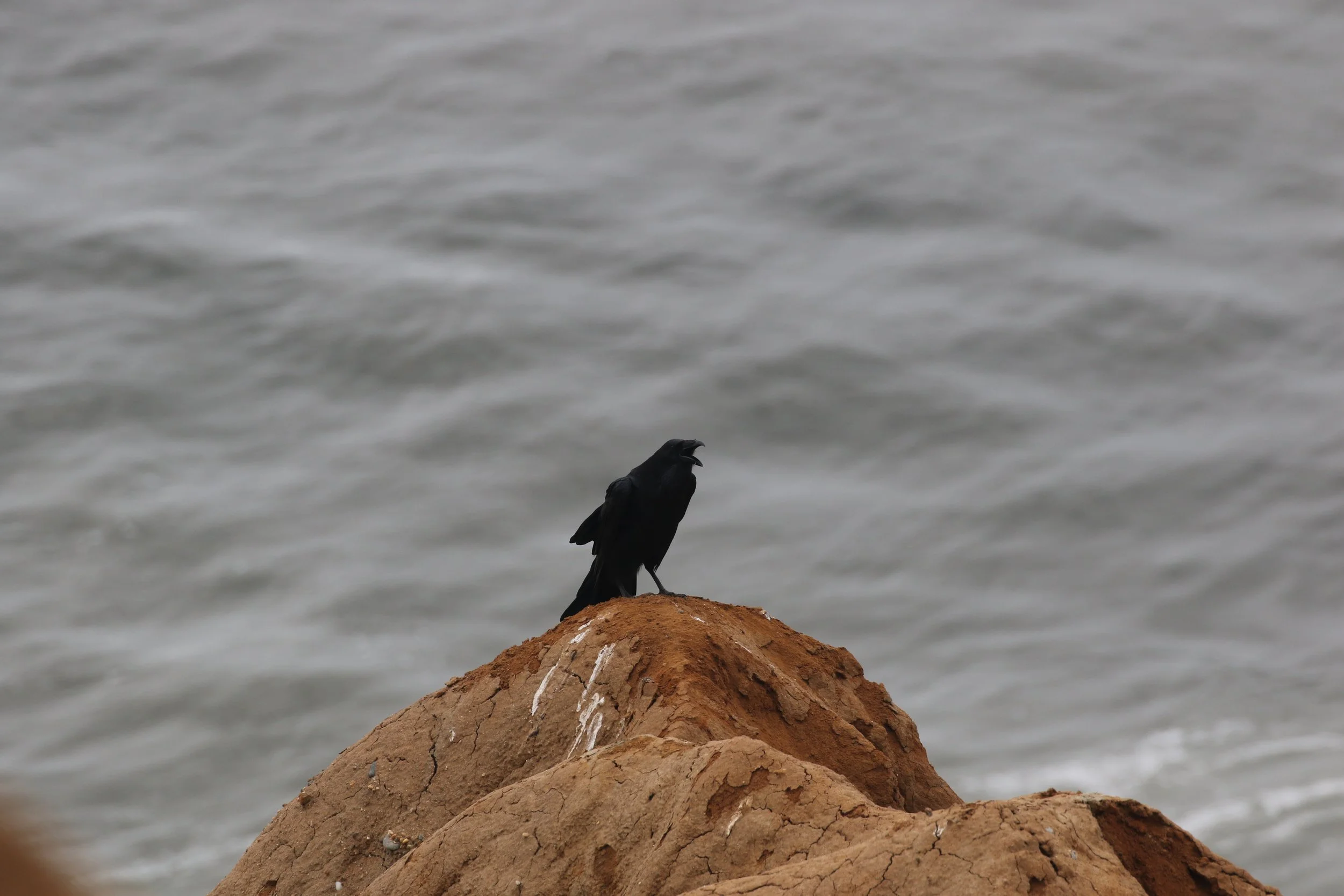
Cultural and Symbolic Meaning of the Crow
Crows represent many different things across various cultures and folklore, some of which are oppositional. It’s no wonder the crow has such a duplicitous reputation.
In Native American folklore, crows have a deep spiritual connection and are considered messengers from the afterlife, serving as a connection to deceased ancestors.
In Celtic folklore, crows are associated with a warrior goddess who could shape-shift into a crow. She would appear prior to battles and hint at the outcome.
In Greek mythology, crows are associated with Apollo, the god of prophecy, and are seen as symbols of insight. In the Greek myth, Apollo sent a white bird to watch over his lover, who later betrayed him. The white bird delivered this news, and in his fury, Apollo curses the bird, turning the feathers from white to black.
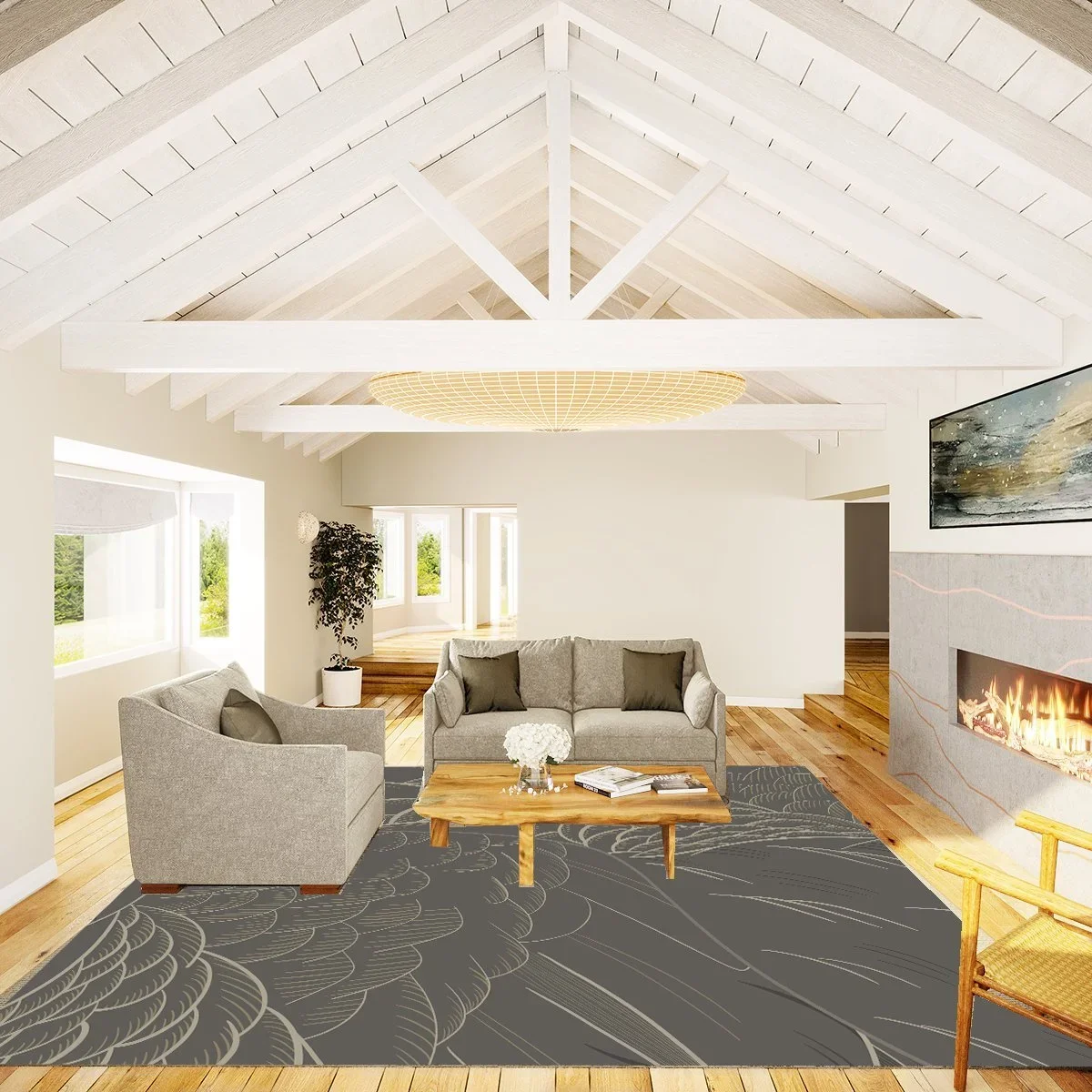
How Crows Can Inspire Interior Design
“Given the cultural and scientific context of the crow, along with its physical properties, the crow can be a meaningful aspect of biophilic design, especially as a motif in textiles, wallpaper, or in artwork,” says Sarah Barnard, WELL and LEED-accredited interior designer. Barnard is an expert in biophilic and wellness-focused design. Her projects are nature-inspired and consider the physical and emotional benefits when the built environment meets biophilia.
Beyond using its beauty to distill beautiful patterns and decor, “Considering and replicating some of the behaviors of this intelligent bird can add nuance to interior design,” she says. Here are some ways to use the crow’s qualities to inspire interior design.
Kale Tree® Crow
Look at Color in Different Ways
When choosing colors, consider how light might affect perception. As with the crow’s feathers, light conditions literally alter the colors, creating a totally different experience. Remember things like light sources, surface finishes, and the size of the space.
Design for Community
Crows are community-centric and deeply interconnected, fostering supportive bonds and yielding benefits. Designing with the same intention, including spaces that foster connection, gathering, and socialization, from furnishings that cluster for conversation to kitchen design that encourages gathering.
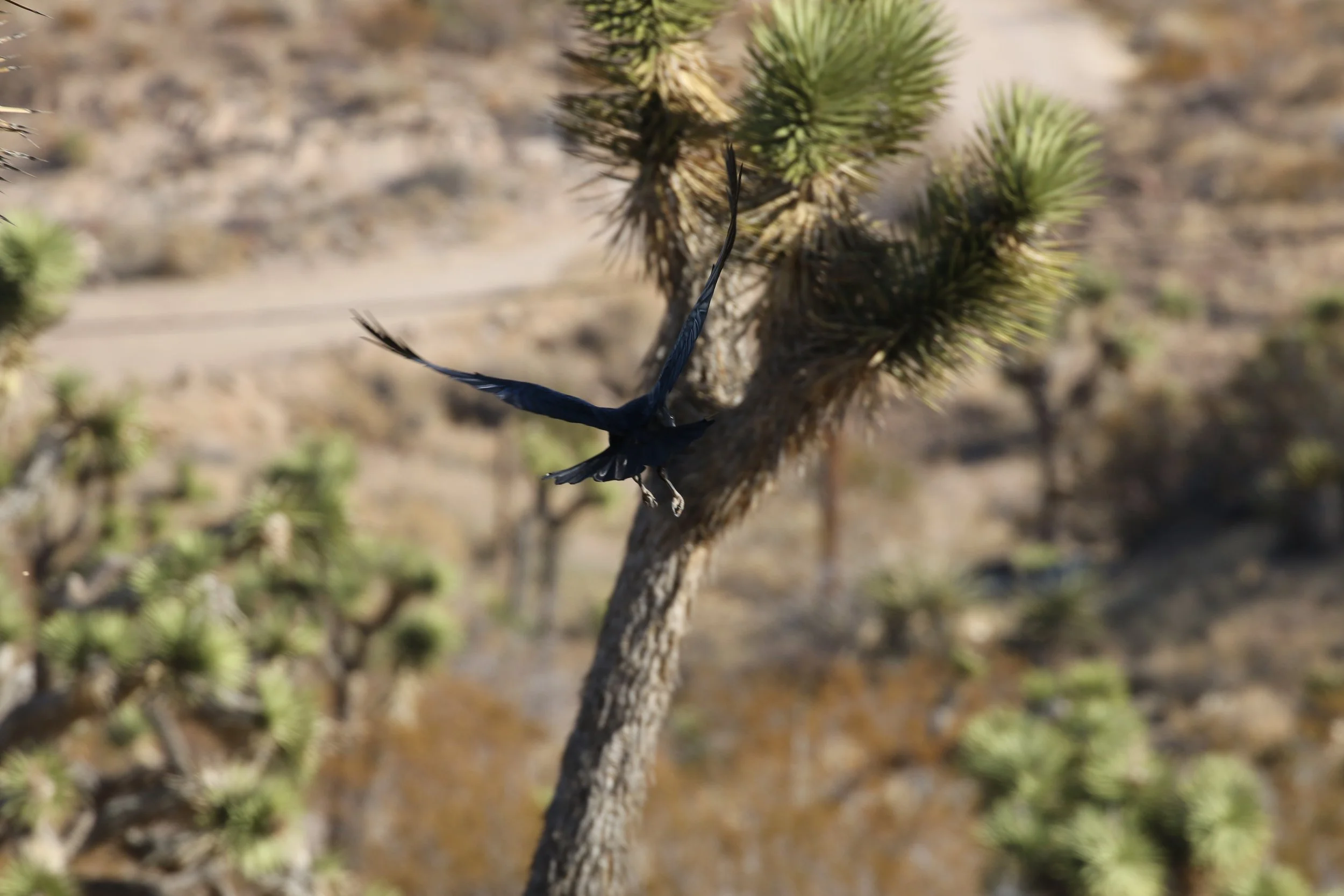
Pensive and Patient
The crow is so smart, in part because of its stop-and-think approach to the world. Granting oneself permission to pause and to create space for patience to observe and consume the surroundings can be grounding. Create space at home dedicated to stillness before action, whether a meditation room, a window seat framed by a view, or a cozy reading nook.
The crow is intelligent, inclusive, and willing to reveal its dark beauty to patient viewers. In a world of digital overwhelm and surface-level impact, the crow is a reminder of the richness of layers, the rewards for patience, and how instincts are centering.
Sources:
https://eugene.wbu.com/american-crow
https://urbannature.blog/2019/11/13/crow-collective
https://www.audubon.org/magazine/meet-bird-brainiacs-american-crow
https://www.centreofexcellence.com/spiritual-meaning-of-a-crow
https://www.learnreligions.com/the-magic-of-crows-and-ravens-2562511
https://birdastic.com/are-crows-bad-omen-symbolism-meaning-explained/#:~:text=Conclusions,you%20choose%20to%20interpret%20them.
https://www.allaboutbirds.org/guide/American_Crow/overview#:~:text=Basic%20Description,rarely%20broken%20up

Birdwatching as mindfulness: Creative connections within the bird watching community.

The benefits of looking at nature are everywhere, no matter where you live. Outdoor recreational activities such as hiking and being in nature promote feelings of well-being. Recent research by academics at the University of Exeter, the British Trust for Ornithology, and the University of Queensland suggests that birding, in particular, has mental health benefits. Researchers in the UK recently determined that people who saw more birds in their daily lives experience less stress and depression. Bird-watching is a practice that encourages mindfulness and patience. Simply watching a bird feeder can be beneficial for your mental health.
Birding also benefits your mental health through the community and friendships that it creates. A love of birding connects people from all walks of life and is what initially drew interior designer Sarah Barnard, WELL AP + LEED AP, to the artwork of Vivienne Edwards.
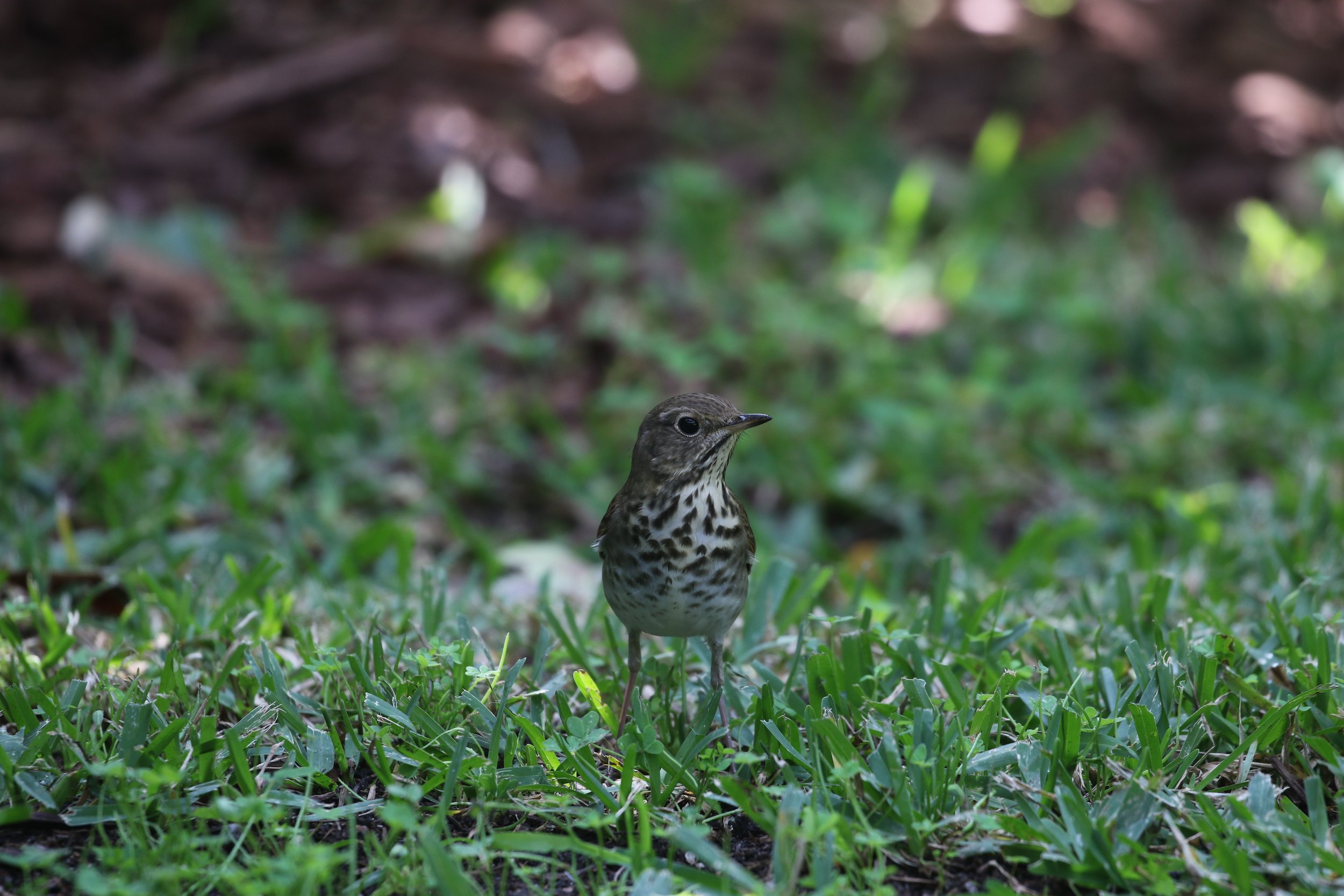
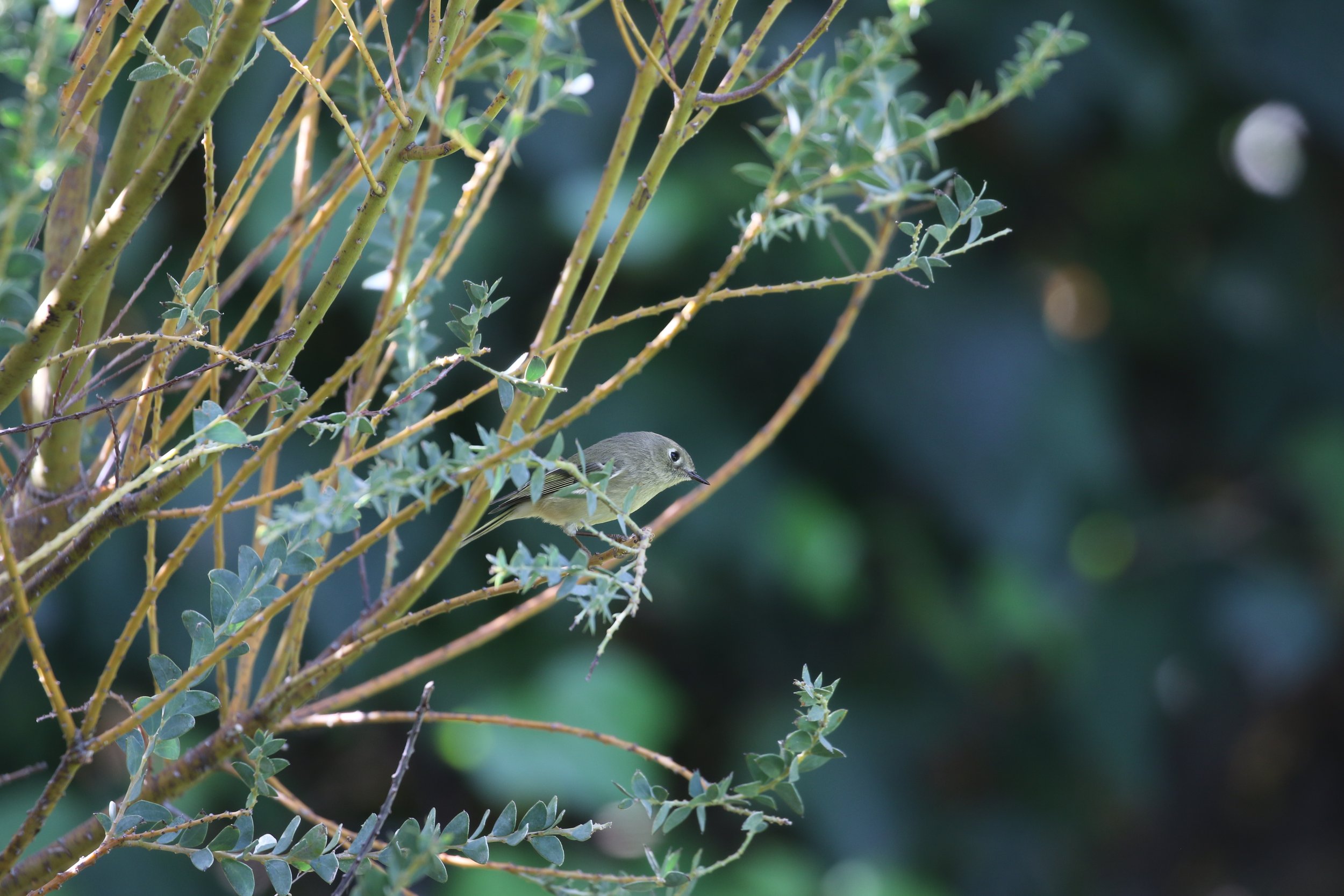
The watercolor paintings of small birds included in several of our mood boards for the Matilija Poppy Textile and the Mallow Textile are by the artist Vivienne Edwards. Vivienne is based in South Africa and makes small watercolors of birds that she encounters in the natural environment around her. Sarah discovered Viviennes' work one day by chance, drawn to the intimacy of their small size (2.5 x 3.5 in) and how they reflect the artist's relationship with her natural surroundings.
Sarah is an avid birder and felt that Vivienne's paintings would be a special addition to her art collection. Sarah commissioned a small set of paintings from Vivienne based on photographs Sarah took of favorite birds in her garden.
These magical birds are featured in a series of Kale Tree mood boards, whose nature-inspired luxury eco fabrics incorporate biophilic prints inspired by the intersection of art, design, and nature. Sarah thought these paintings contributed to the overall feeling of these mood boards, which feature a series of natural materials and textures that help visualize the collection of objects that make up an interior space.
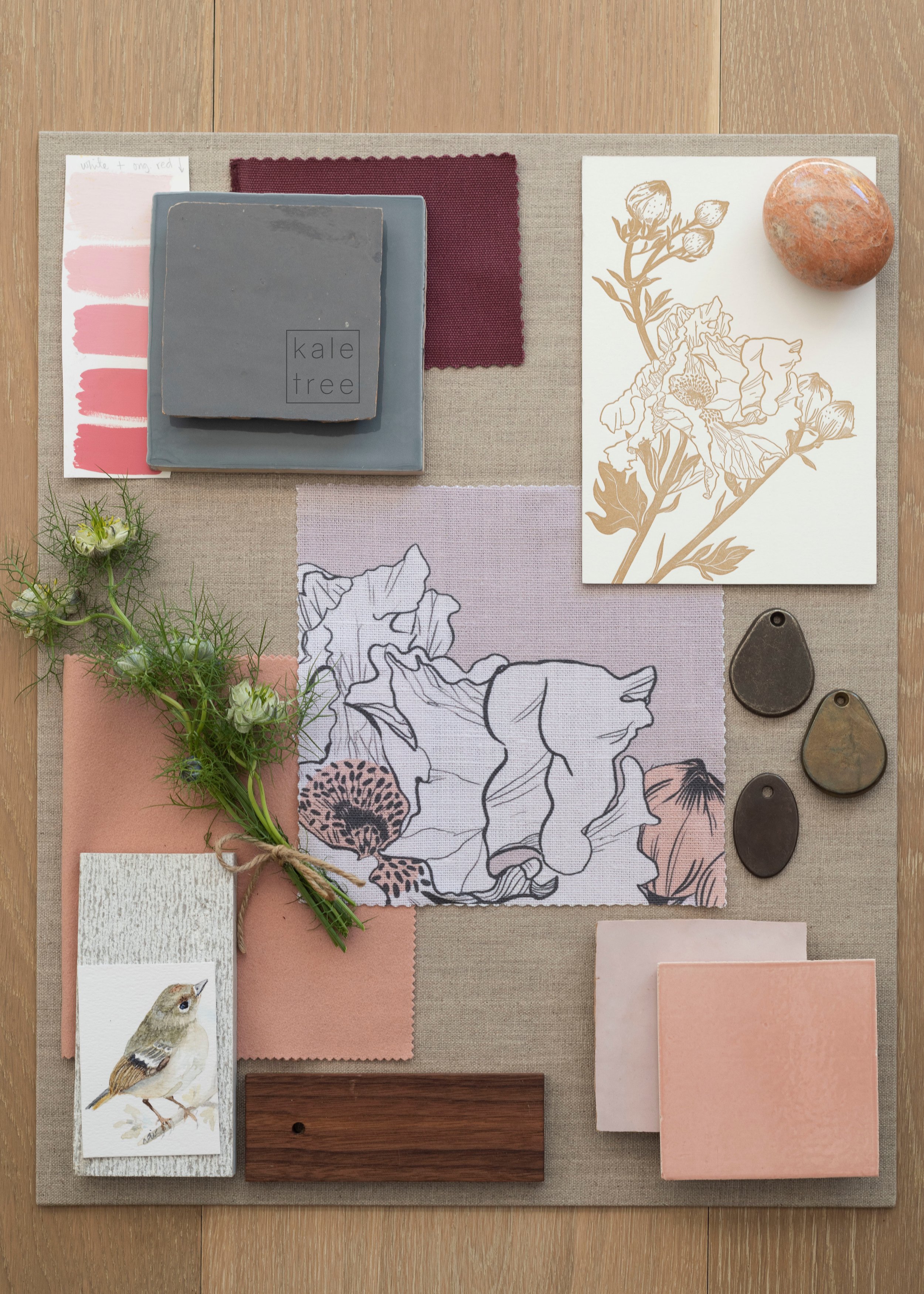
The bird featured in this Kale Tree mood board for the Matilija Poppy Textile in Putty is a Ruby-crowned Kinglet (Regulus calendula); this is a tiny, very cautious bird that can be quite timid. Sarah has mainly spotted the Ruby-crowned Kinglet in the Acacia cultriformis tree in her garden, which it uses as a safe passage to the water bowl. It is a fairly solitary bird that does not stay out in the open for too long. Its ruby crown is very subtle, making it difficult for her to identify at first, and she was very happy when she did. The hand-drawn pattern of this floral textile is inspired by Matilija Poppies (Romneya coulteri), a favorite California native flower.

The Hermit Thrush (Catharus guttatus), is a bird with which Sarah feels a real fascination and kinship. Of all the songbirds, the Hermit Thrush is considered to have one of the most beautiful songs. The first time Sarah saw a Hermit Thrush, she was overcome and entranced by the beauty of this bird which felt like it had a magic quality. The Hermit Thrush is quite solitary; it moves along the edges of the garden with cautious stealth, so it feels like a special moment when it is spotted. Hermit Thrushes seldom visit backyards making this sighting and painting all the more special, a beautiful and meaningful addition to the Matilija Poppy Textile (Midnight) mood board from Kale Tree.
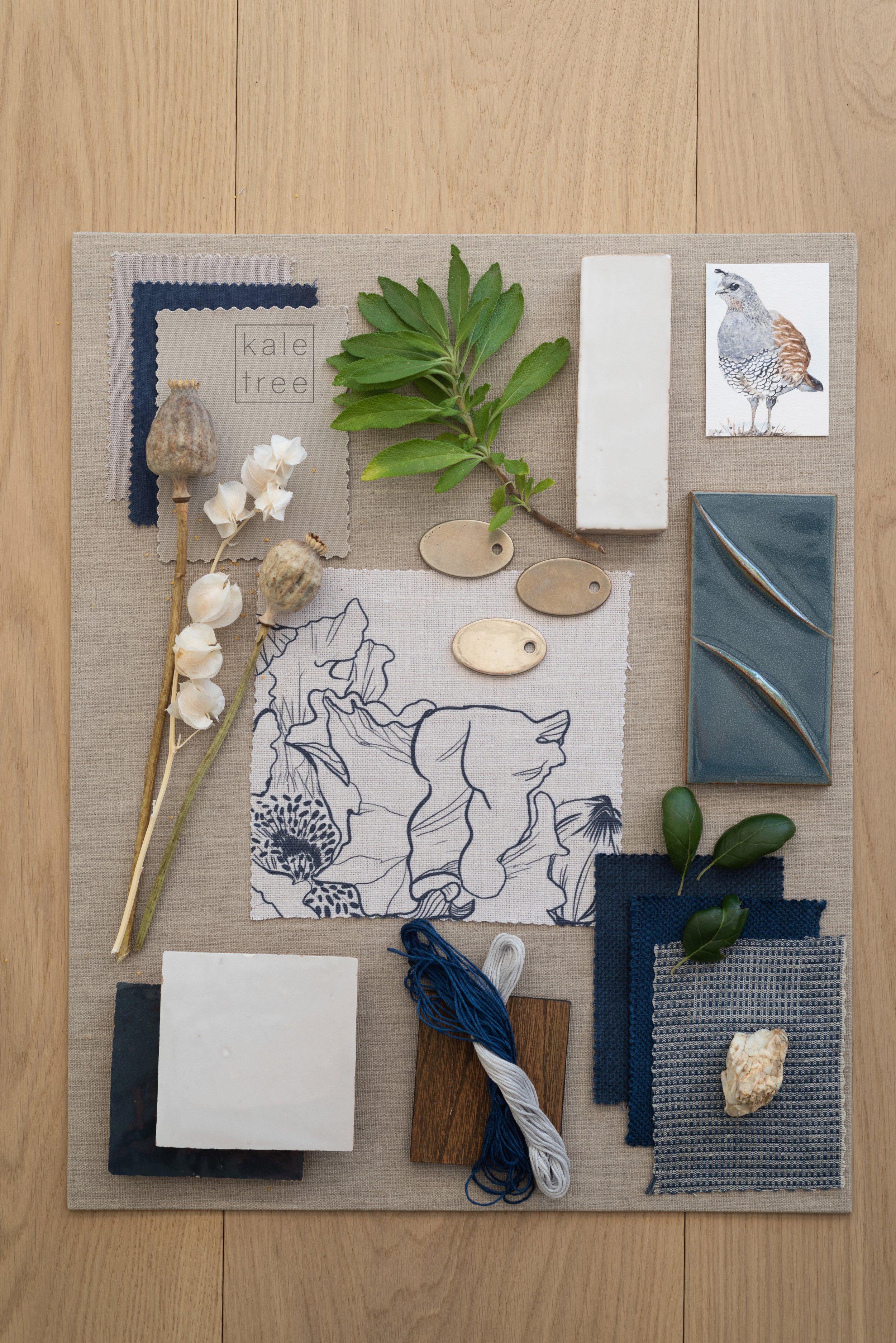
The mood board for the Matilija Poppy Textile (Bluestone) features a painting of the California Quail (Callipepla californica), the California state bird. This bird has beautiful feather patterns and enchanting qualities similar to the hermit thrush. Sarah had only ever seen California Quails in the desert until she moved to her new house, where she saw a pair walk across her patio one day. This experience was delightful and magical as it possibly meant they were nesting nearby. Sarah intends to plant a quail bush (Atriplex lentiformis) in her garden to encourage the birds to stay a while.

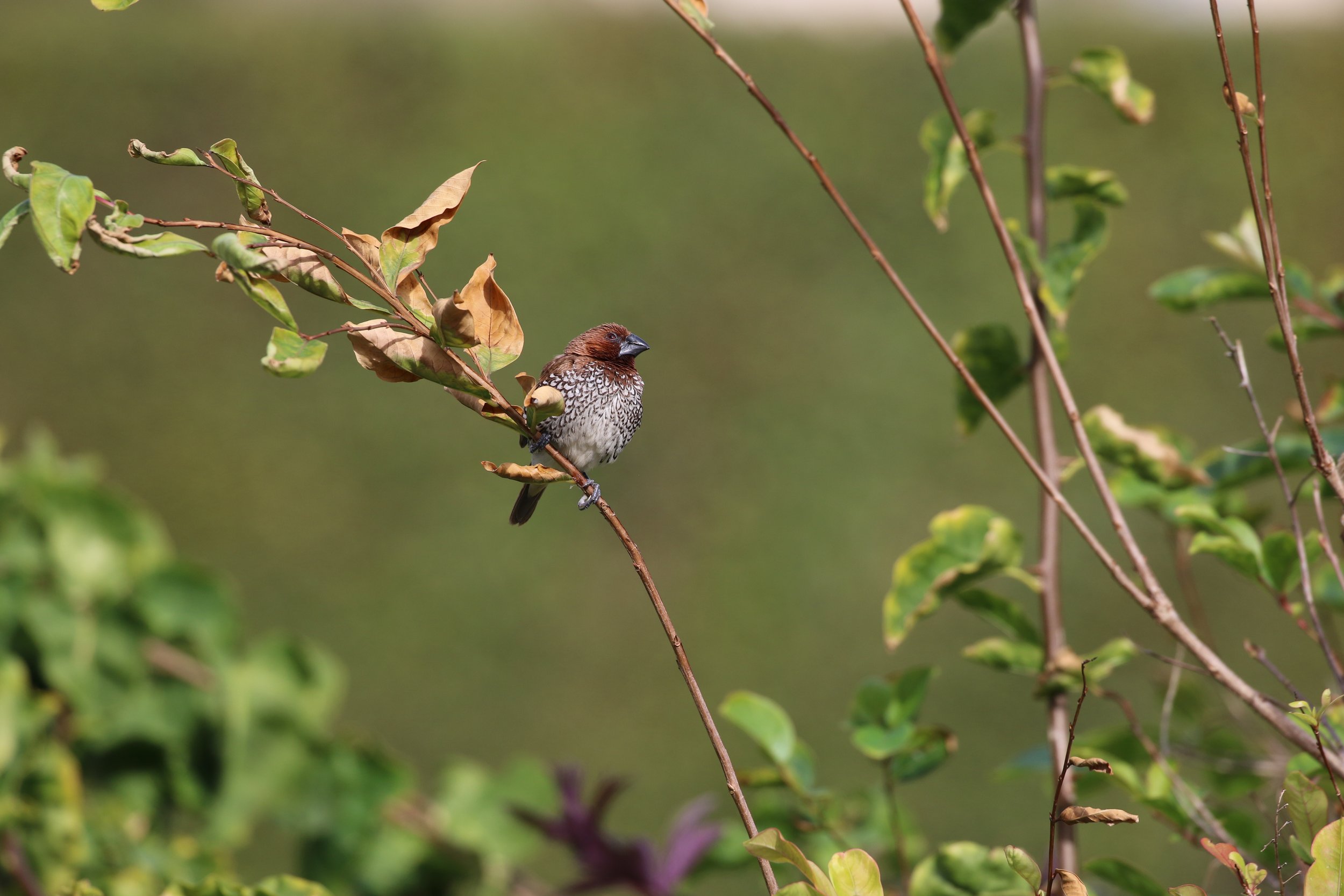
The painting featured in the mood board for the Matilija Poppy Textile (Natural) is of a Scaly Breasted Munia (Lonchura punctulata). You can usually find this small songbird in grasslands, gardens, and fields; the scaly spots on its underbelly and the color palette of its feathers compliment the stamens in the center of this poppy textile. Sarah first saw this bird in her garden and had never seen a bird like it before. She was surprised to learn that it was an introduced species from South East Asia. On watching this bird, she was struck by how familial and social they are; they are hardly ever seen alone and are often spotted sharing food and space. The Scaly Breasted Munia is also a lot less timid around humans, usually happy to sit and listen to a little bit of a human-to-bird conversation.

A painting of a Bewick's Wren (Thryomanes bewickii) is paired alongside a series of natural materials in the mood board for the Mallow Textile (Evening Mauve). The Bewick's Wren was originally one of Sarahs' favorite birds and has been in Sarahs' life for a long time. At her last house, a mother Bewick's Wren, taught her babies to eat suet cake from her bird feeder. The mother wren would also leave baby birds in a bush in Sarahs' garden while they went to forage, allowing her to spend some time with these usually solitary birds. Although they are usually found in dry bushy areas, the Bewick's Wren is also at home in gardens and parks in suburbs and cities. Its ability to live in natural and built environments creates a lovely allegory reflecting the design philosophy behind this floral fabric.
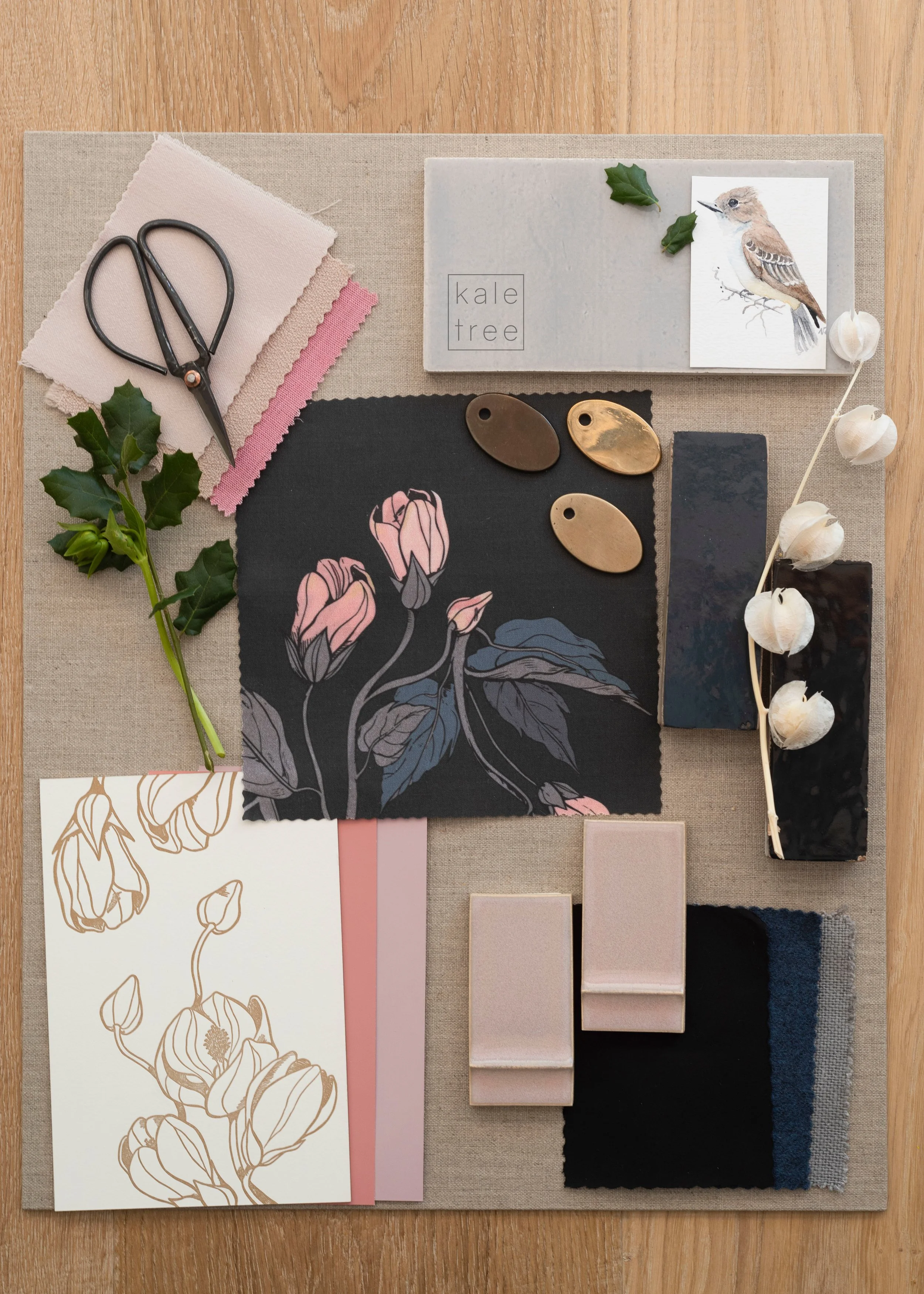
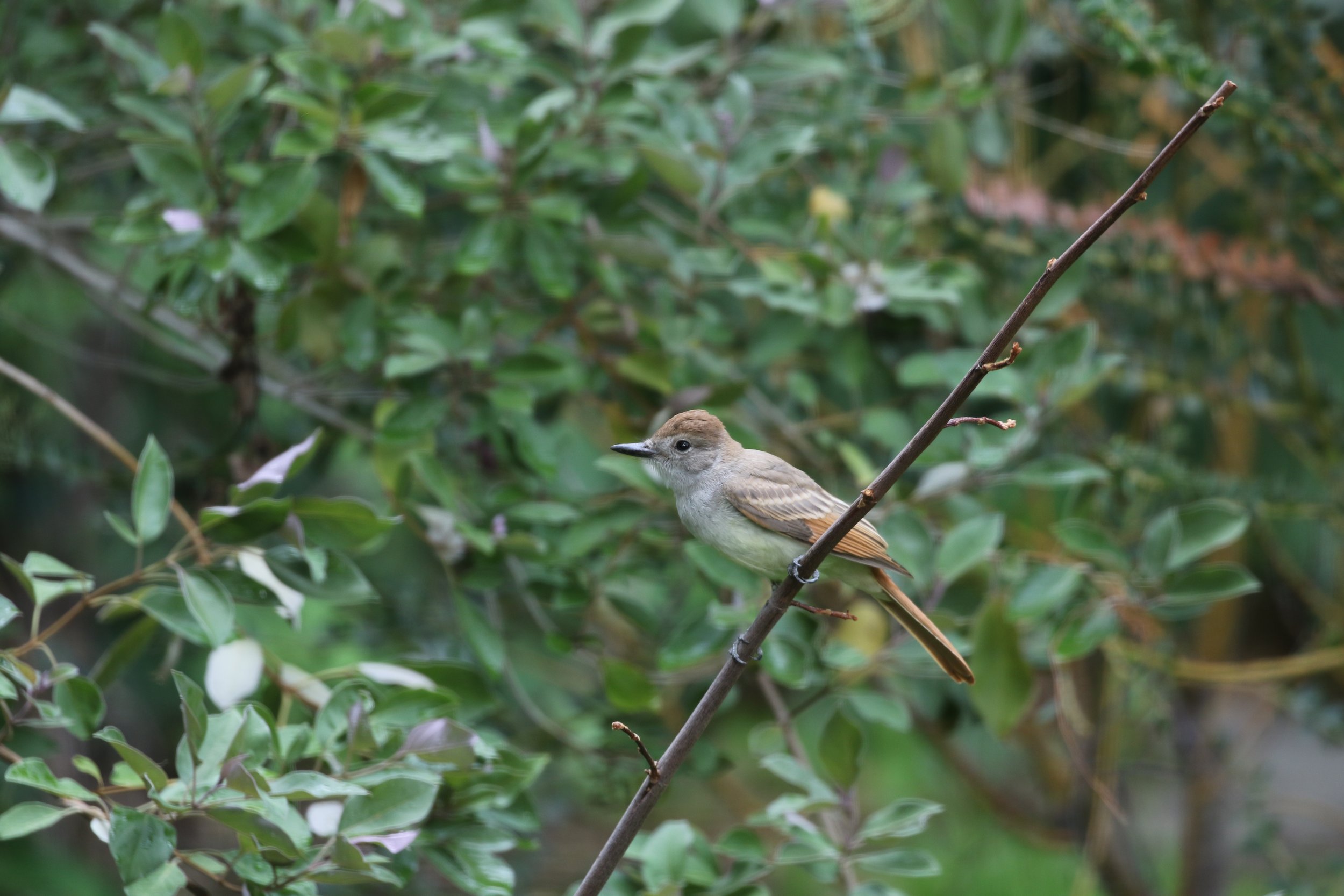
In this last mood board, a painting of an Ash-throated Flycatcher (Myiarchus cinerascens) accompanies a swatch of the Mallow Textile (Midnight Forest). These birds are often found in dry places, and as a result, they don't need to drink much water. Instead, they get the water they need from their food. Sarah often sees these birds in her garden, but explains that patience is required as they are usually on a perch somewhere, sitting, waiting, and surveying for insects that they catch in mid-flight.
Vivienne Edwards is a self-taught artist from South Africa who loves to work with the unpredictability of watercolors. She is fortunate to live in a wildlife-rich region with abundant bird life and wetlands. Her work takes inspiration from the small creatures in the natural environment around her, going about their daily lives with such purpose and energy. It is often a show of vulnerability from this wildlife that prompts what she decides to paint, such as a Sparrow delicately picking a sprig of parsley for its young.
Sarah and her team love working with other artists, especially those who celebrate the beauty of nature and inspire joy through their work.

Bibliography
“Beautiful Birding: 7 Mental Health Benefits of Bird Watching.” Happiness.com, 27 Jan. 2022, https://www.happiness.com/magazine/art-culture-leisure/mental-health-benefits-of-bird-watching/.
Leahy, Christopher W. “Teaching Your Mind to Fly: The Psychological Benefits of Birdwatching.” Princeton University, The Trustees of Princeton University, 31 July 2021, https://press.princeton.edu/ideas/teaching-your-mind-to-fly-the-psychological-benefits-of-birdwatching.
Ray, Heather. “A Dose of Nature: Why Birding Will Boost Your Mental Health.” Birds and Blooms, Birds and Blooms, 27 Apr. 2022, https://www.birdsandblooms.com/birding/birding-basics/birding-health/#:~:text=Researchers%20in%20Kentucky%20found%20that,beneficial%20to%20your%20psychological%20health.
Sarah Barnard is a WELL and LEED accredited designer and creator of environments that support mental, physical and emotional wellbeing. She creates highly personalized, restorative spaces that are deeply connected to art and the preservation of the environment. An advocate for consciousness, inclusivity, and compassion in the creative process, Sarah has appeared in Architectural Digest, Elle Décor, Vogue, HGTV and many other publications. In 2017 Sarah was recognized as a "Ones to Watch" Scholar by the American Society of Interior Designers (ASID).

Views from the Garden: Hibiscus, Roses, Birds + Bees
Hibiscus has always been one of my favorite flowers, with its colorful voluptuous blooms. What began as a tiny one-gallon pot is now (years later) a magnificent bush, a bit taller than me.
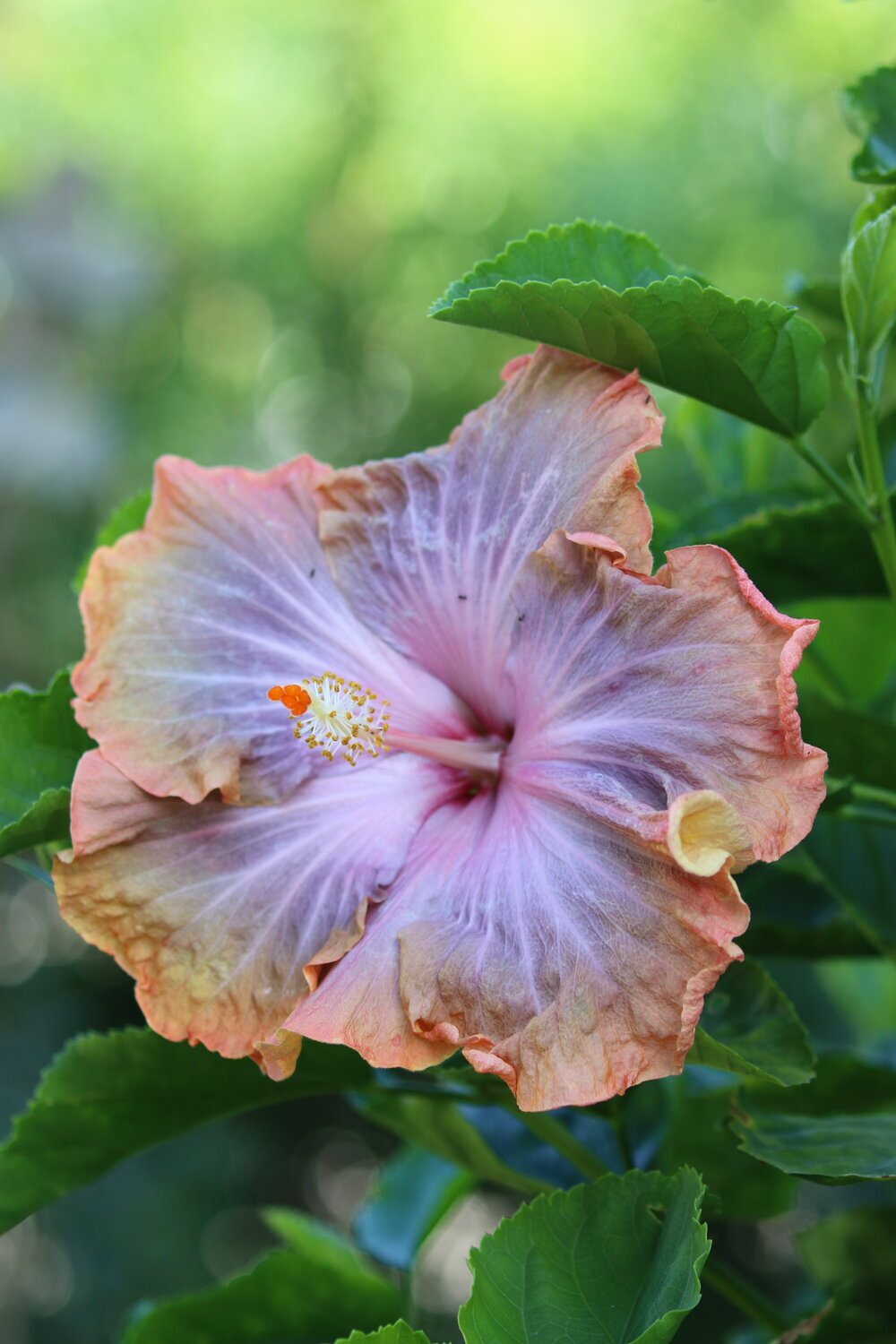
HIBISCUS ROSA-SINENSIS “CREOLE LADY” . LOS ANGELES, CA.
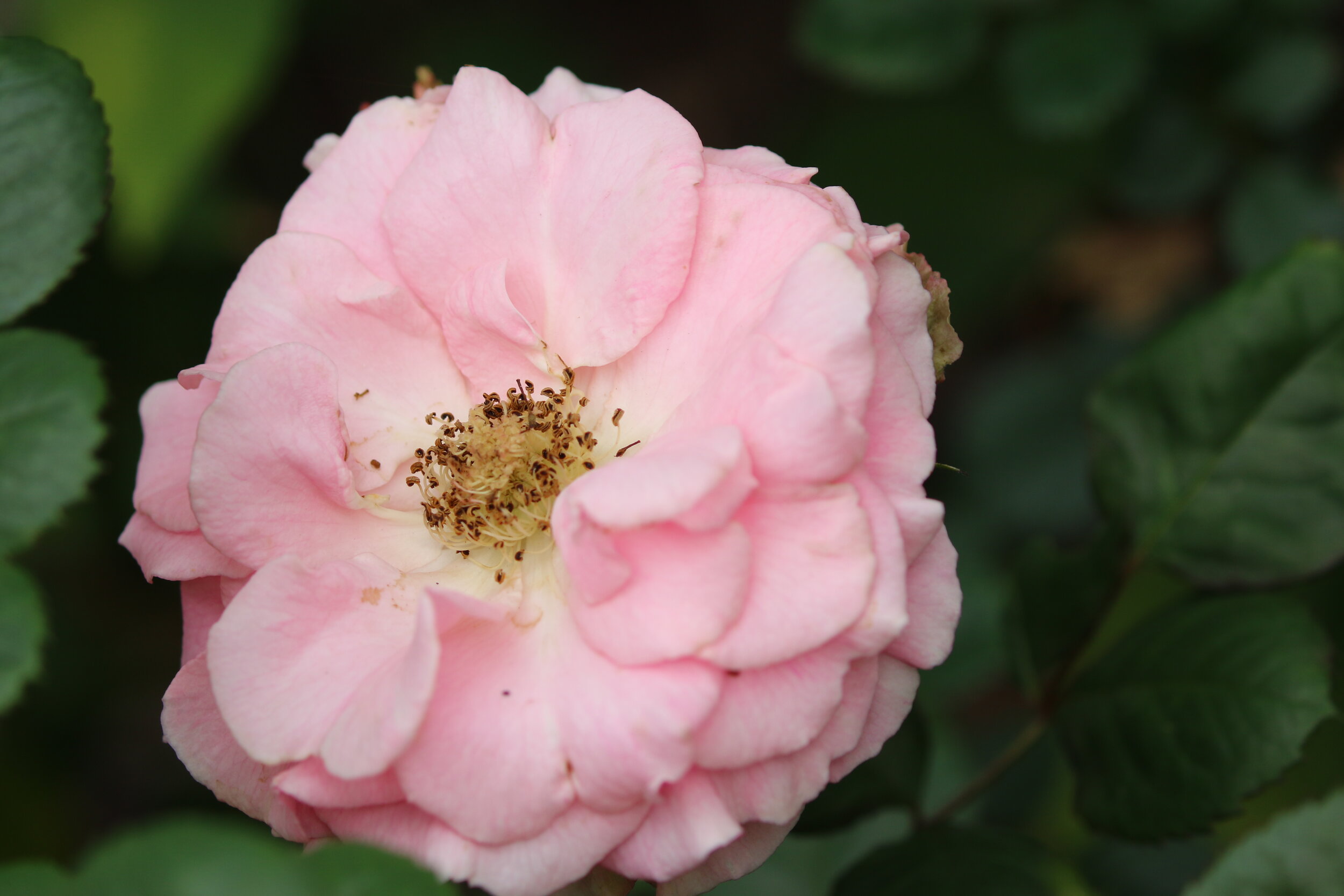
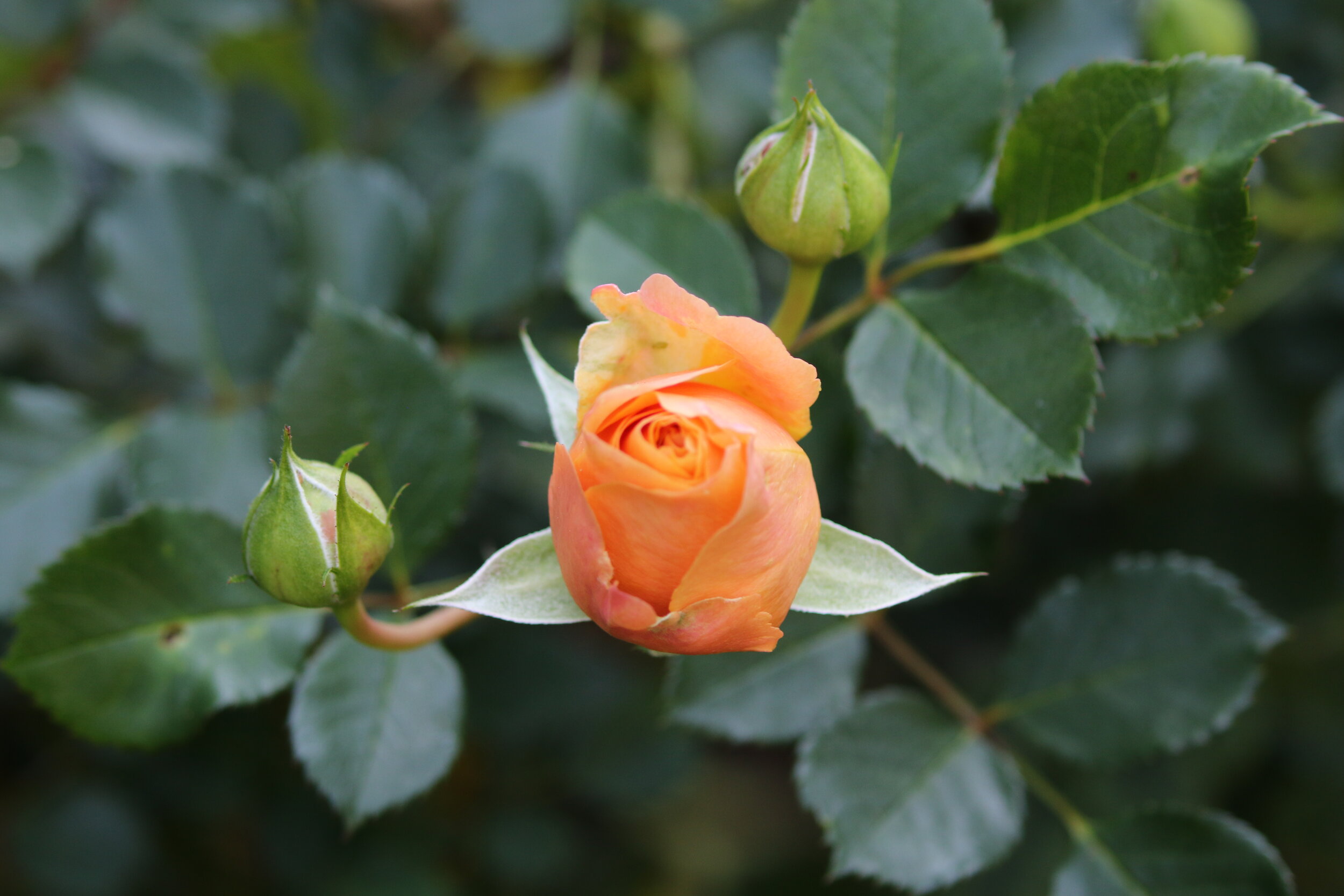
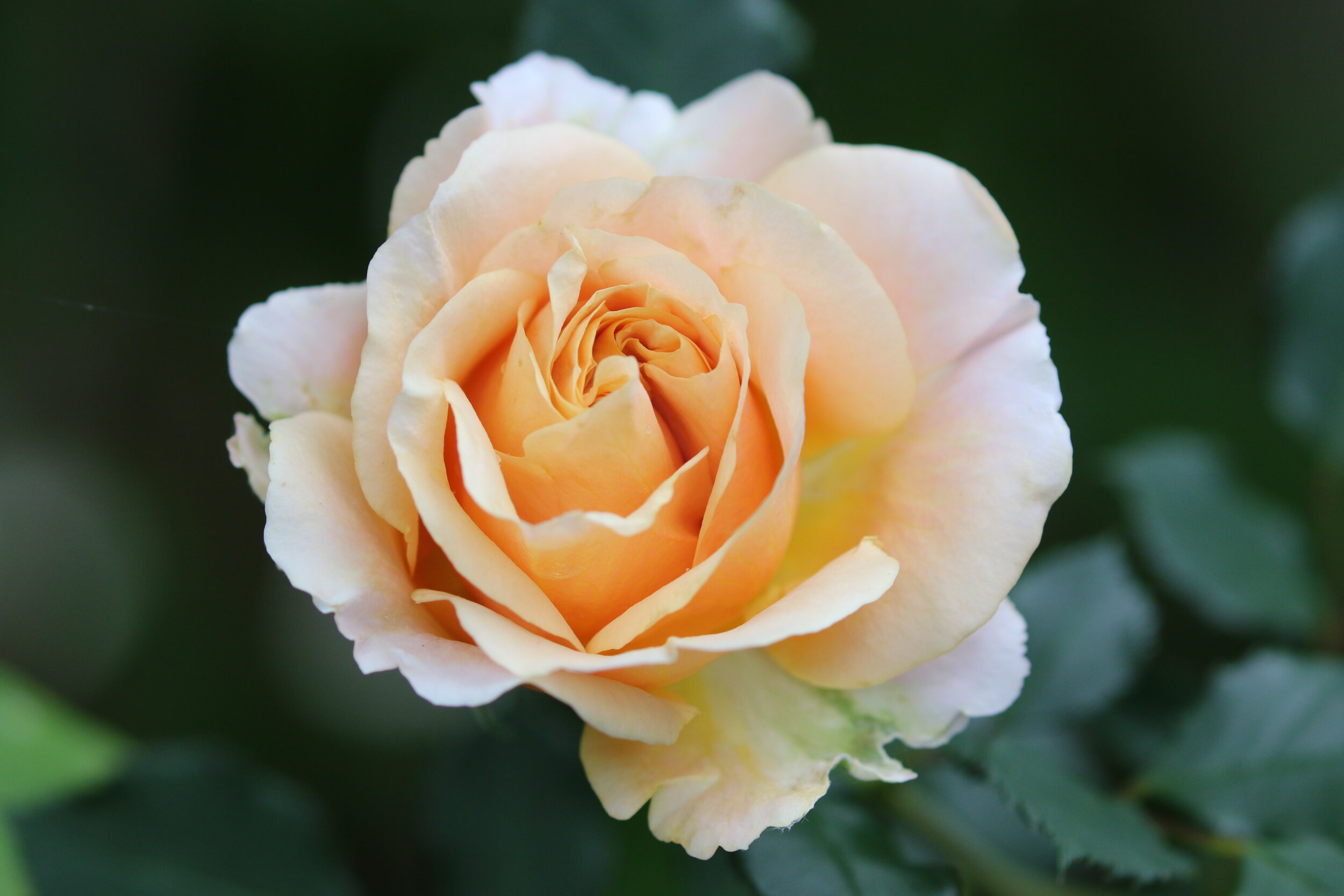
Hibiscus has always been one of my favorite flowers, with its colorful voluptuous blooms. What began as a tiny one-gallon pot is now (years later) a magnificent bush, a bit taller than me. Garden roses are one of my simplest delights. The fragrance of roses inspires cheer in my southern California garden nearly all year round. Spending a bit of time outdoors each morning helps me to feel connected to the outside world.
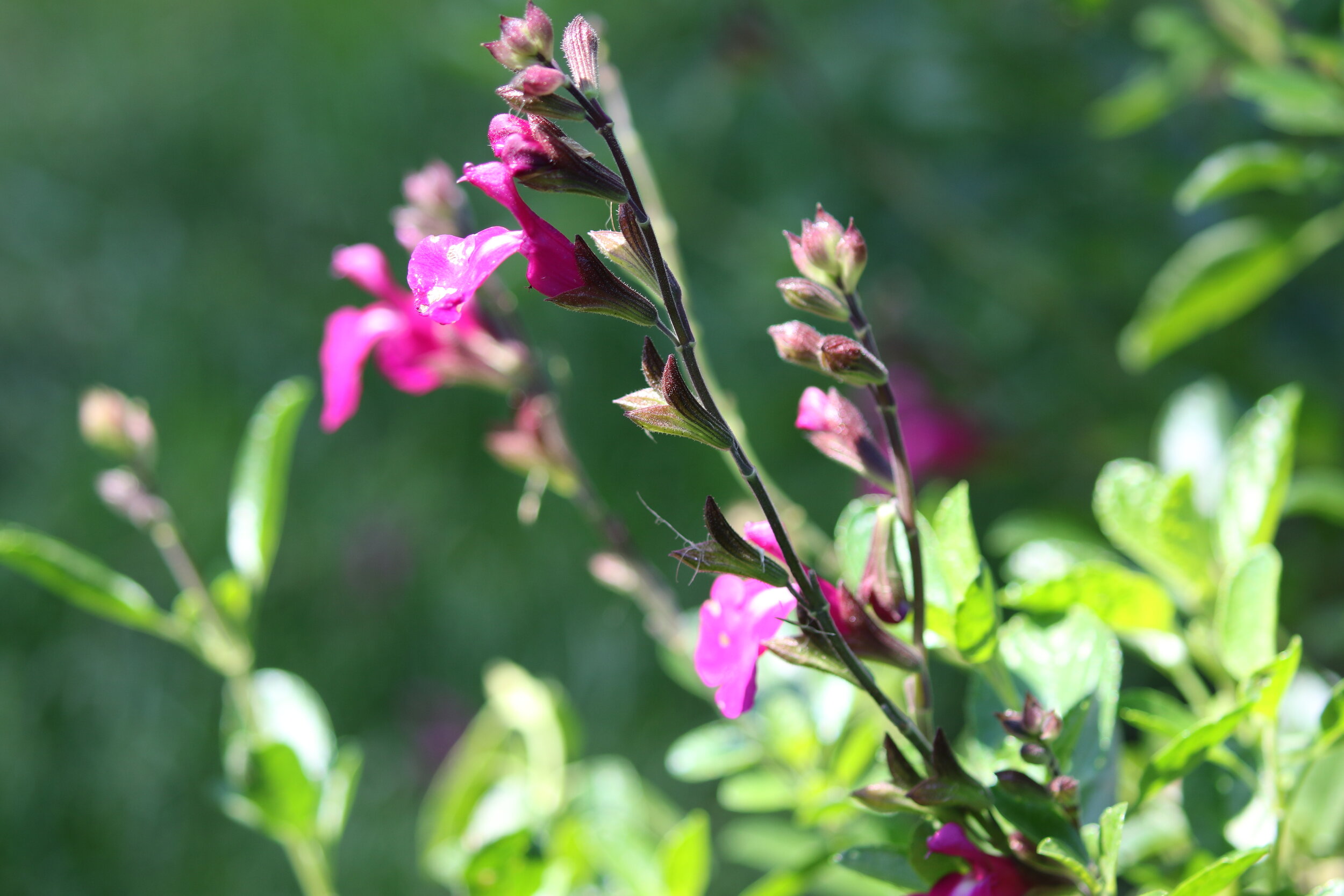

A COMMON HOUSE SPARROW FINDS A TASTY NUT. LOS ANGELES, CA
Visiting birds and bees remind me that life is in fact carrying on, no matter the state of my day, or the world at large.

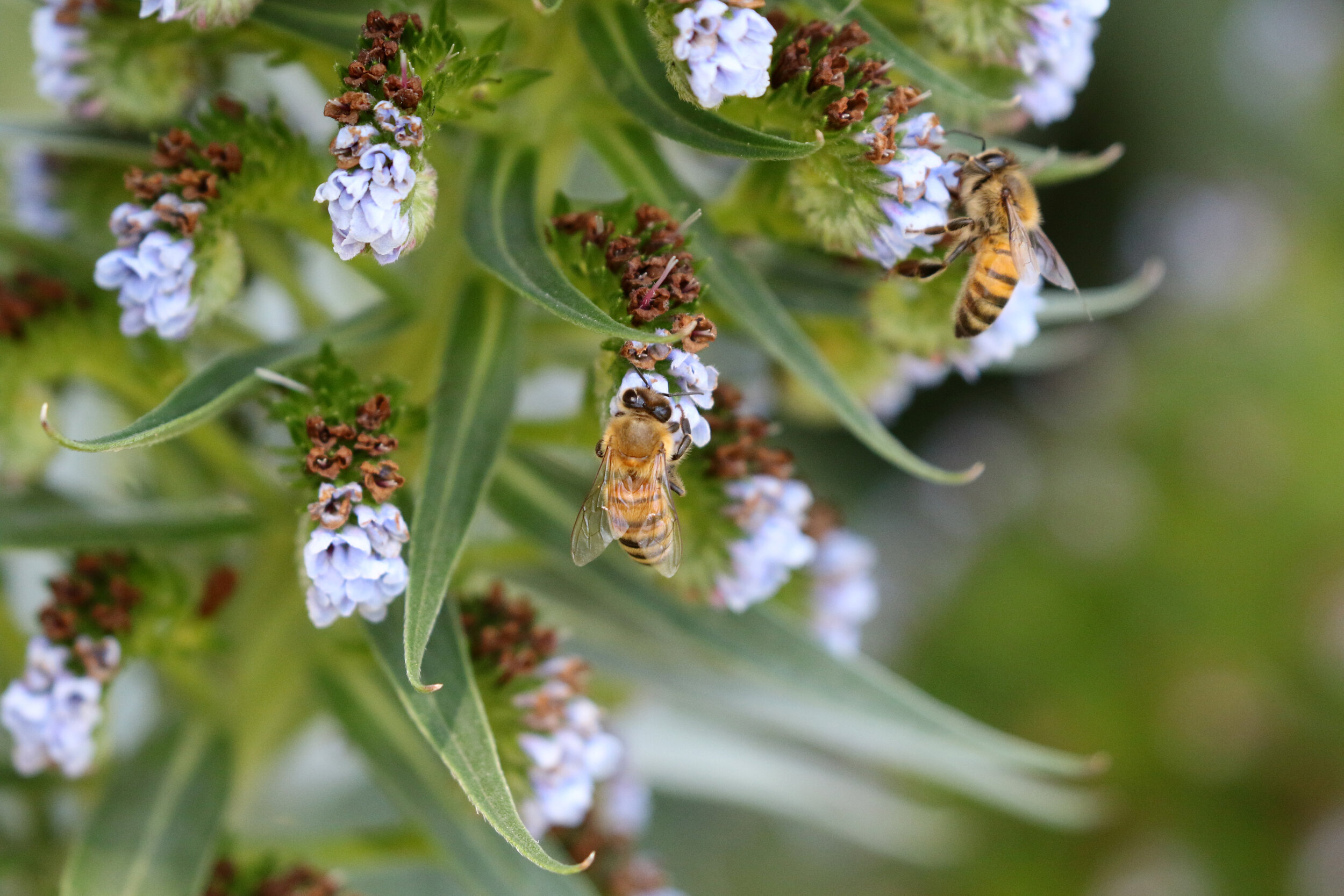
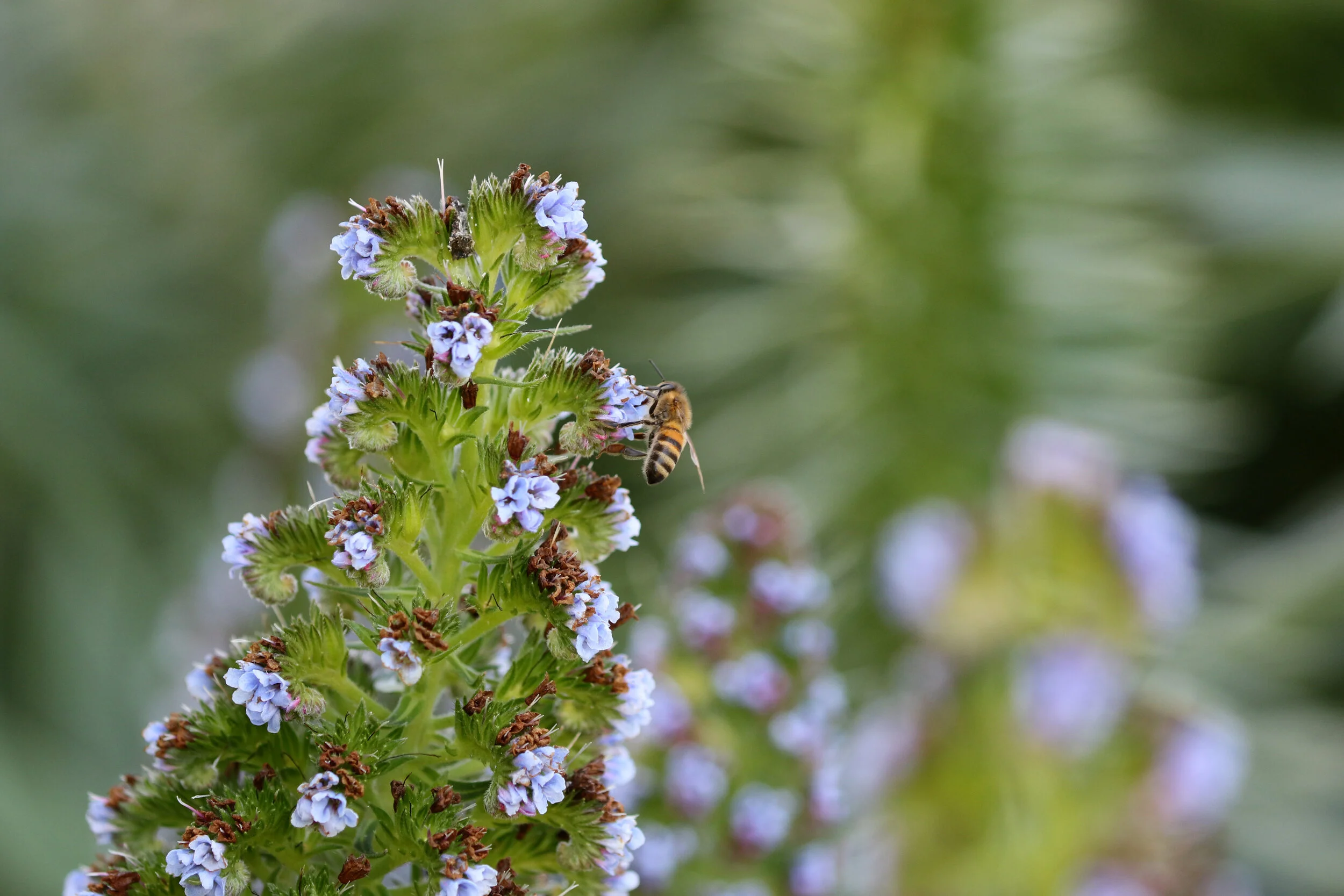
ECHIUM CANDICANS, PRIDE OF MADEIRA, A FAVORITE OF THE VISITING BEES. LOS ANGELES, CA.
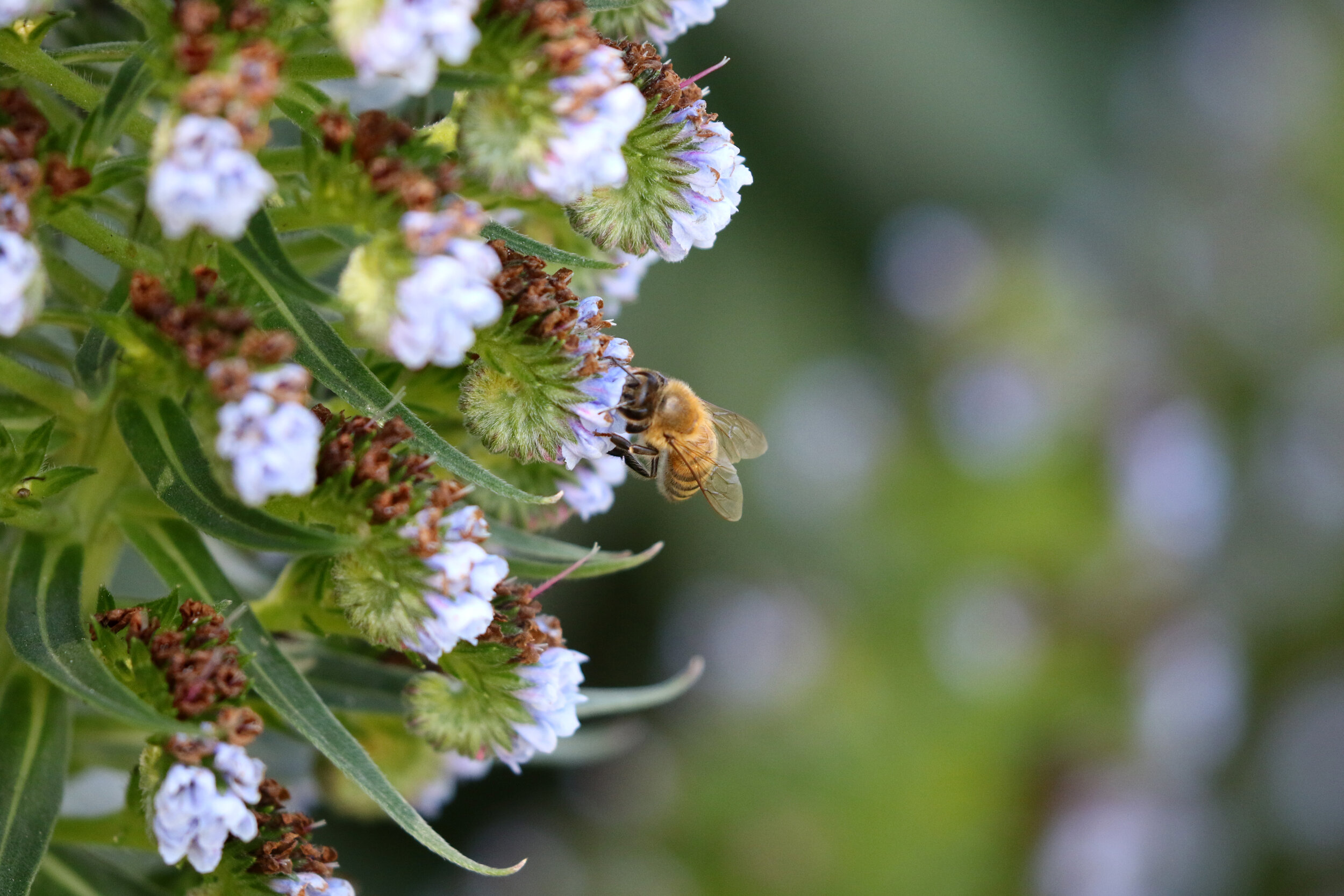
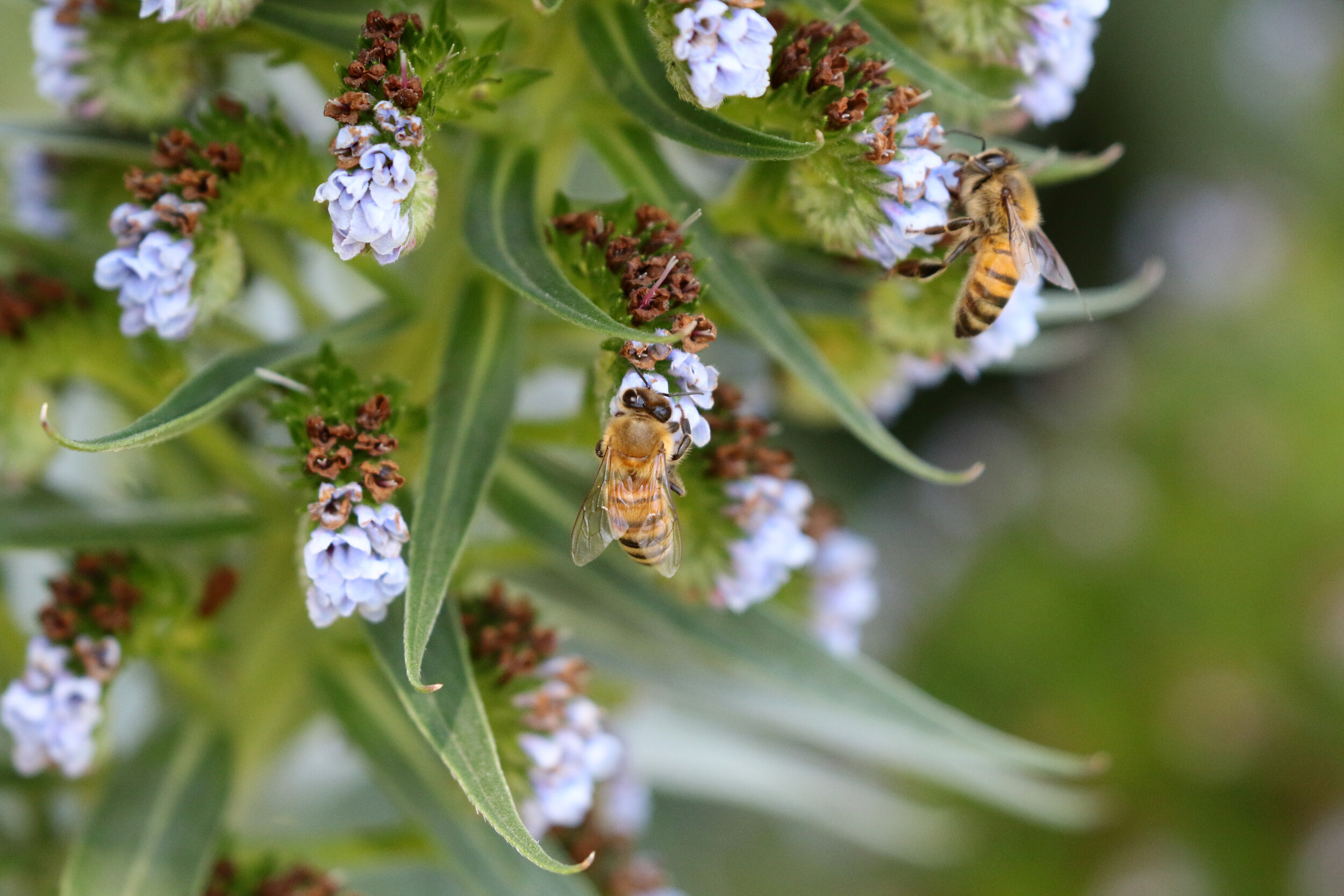
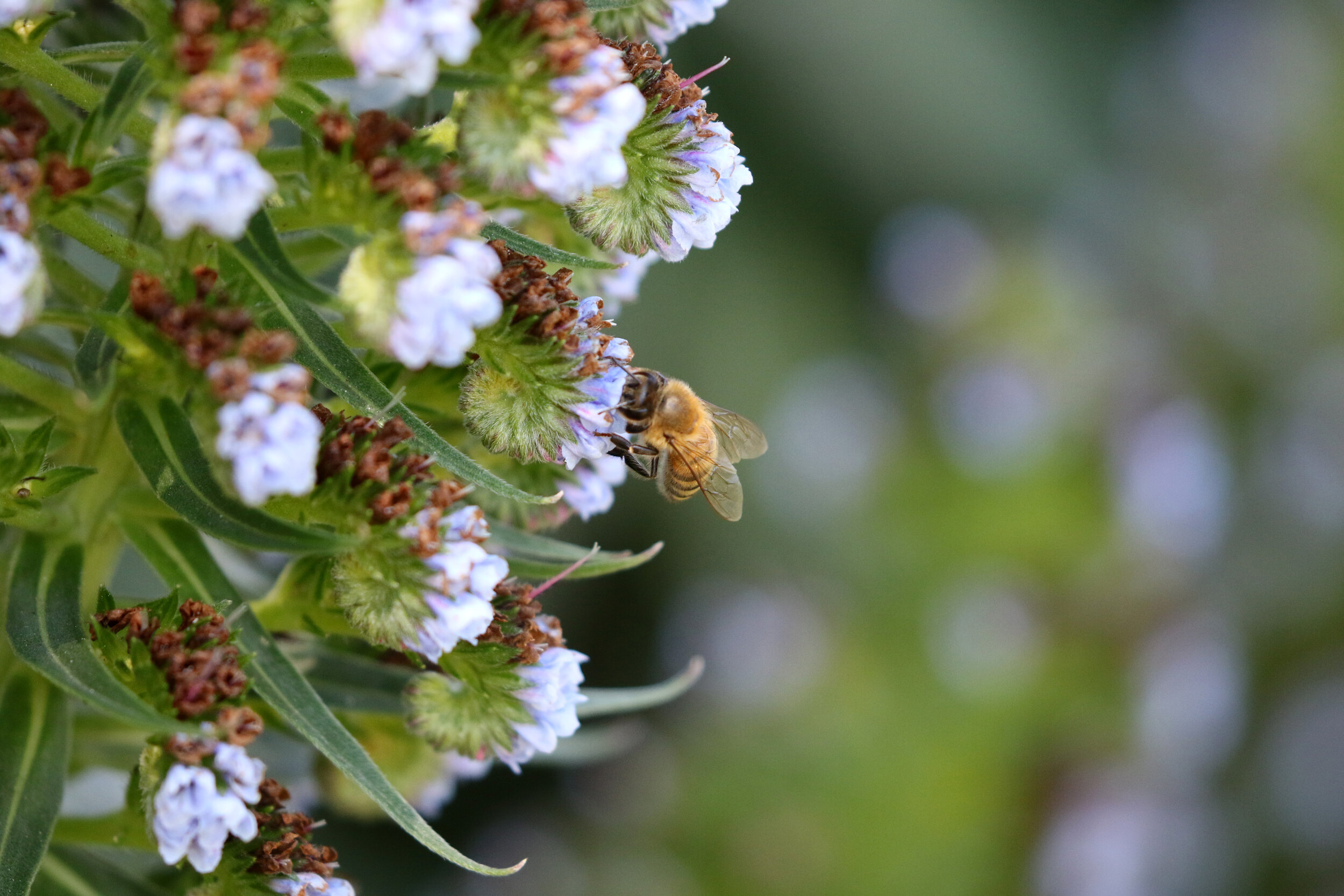
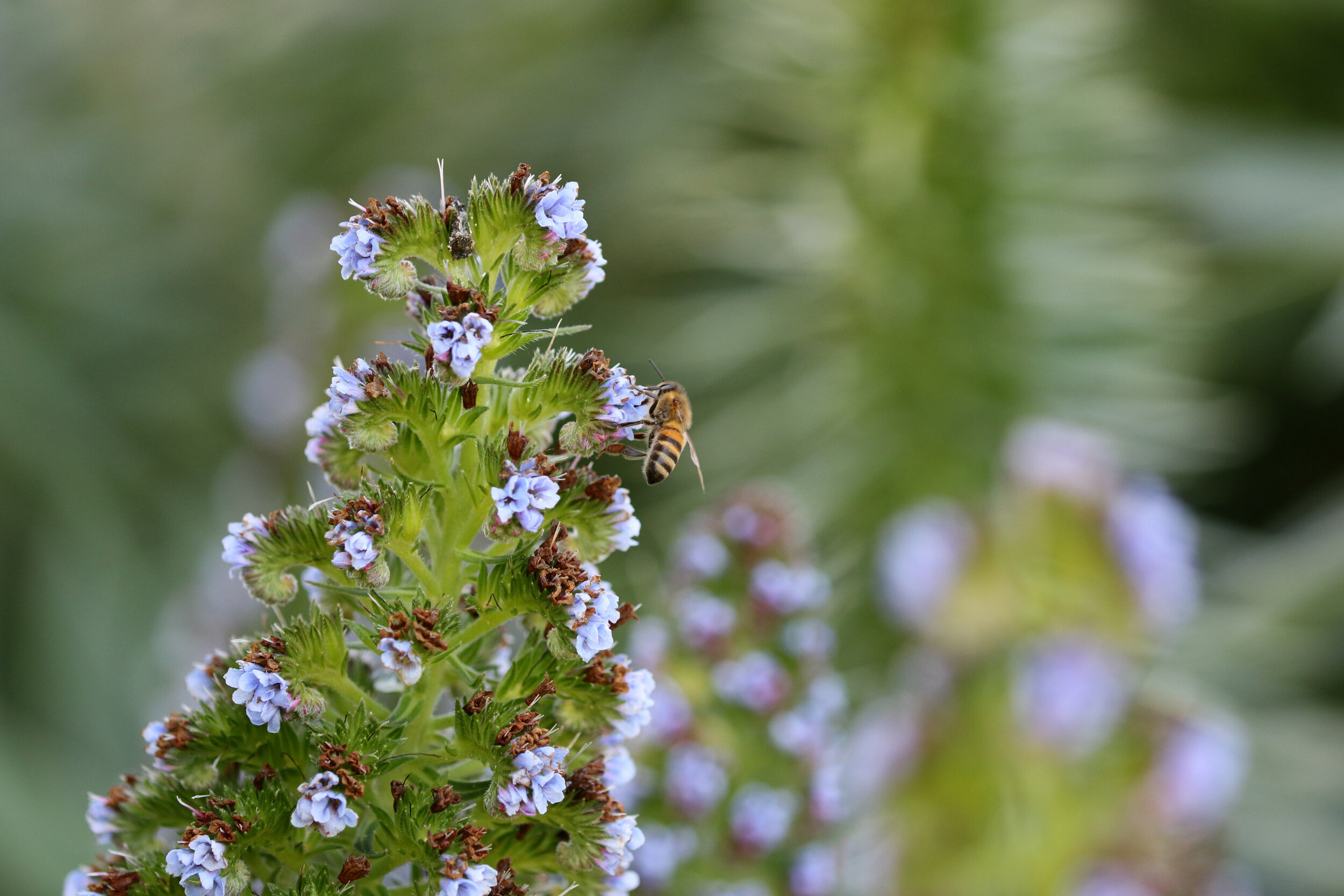

A CARPENTER BEE VISITS THE SENNA FLOWERS. LOS ANGELES, CA.