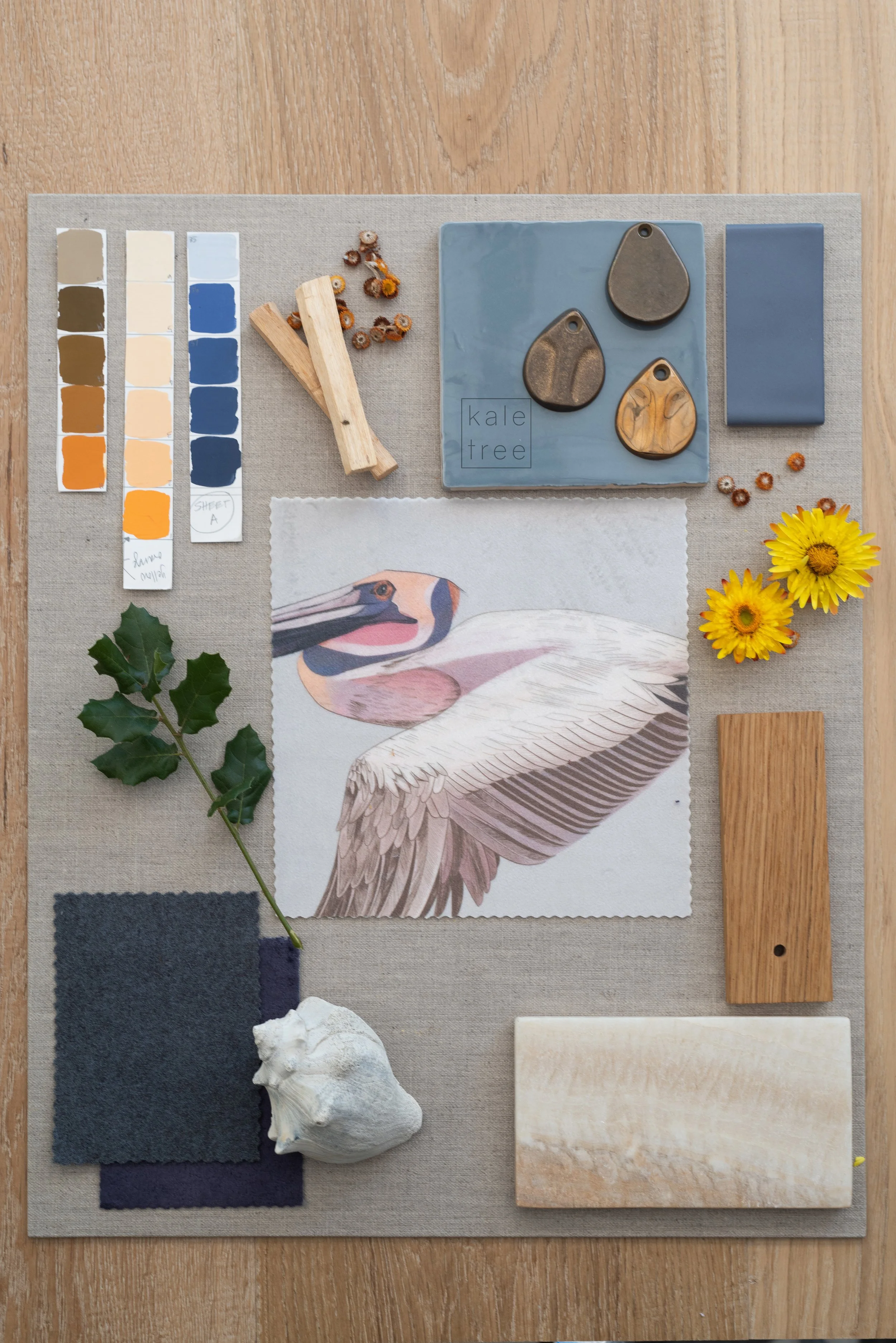
California Brown Pelican + Home Decor
California has long been defined by its coastline, which attracts many people and wildlife to the region. The distinctive conditions along the coast support a diverse ecosystem unique to the area, where many animals can be found in few other places. One of these beloved animals is the California Brown Pelican, a beautiful bird that, much like its namesake state, bridges the gap between land and sea.
Do California brown pelicans live only in California?
While California Brown Pelicans can be found along the coasts of the Americas from Vancouver to Nayarit, Mexico, their breeding range is even more limited, with the only breeding colonies in the United States found in Southern California, within the Channel Islands.
Why the California Brown Pelican?
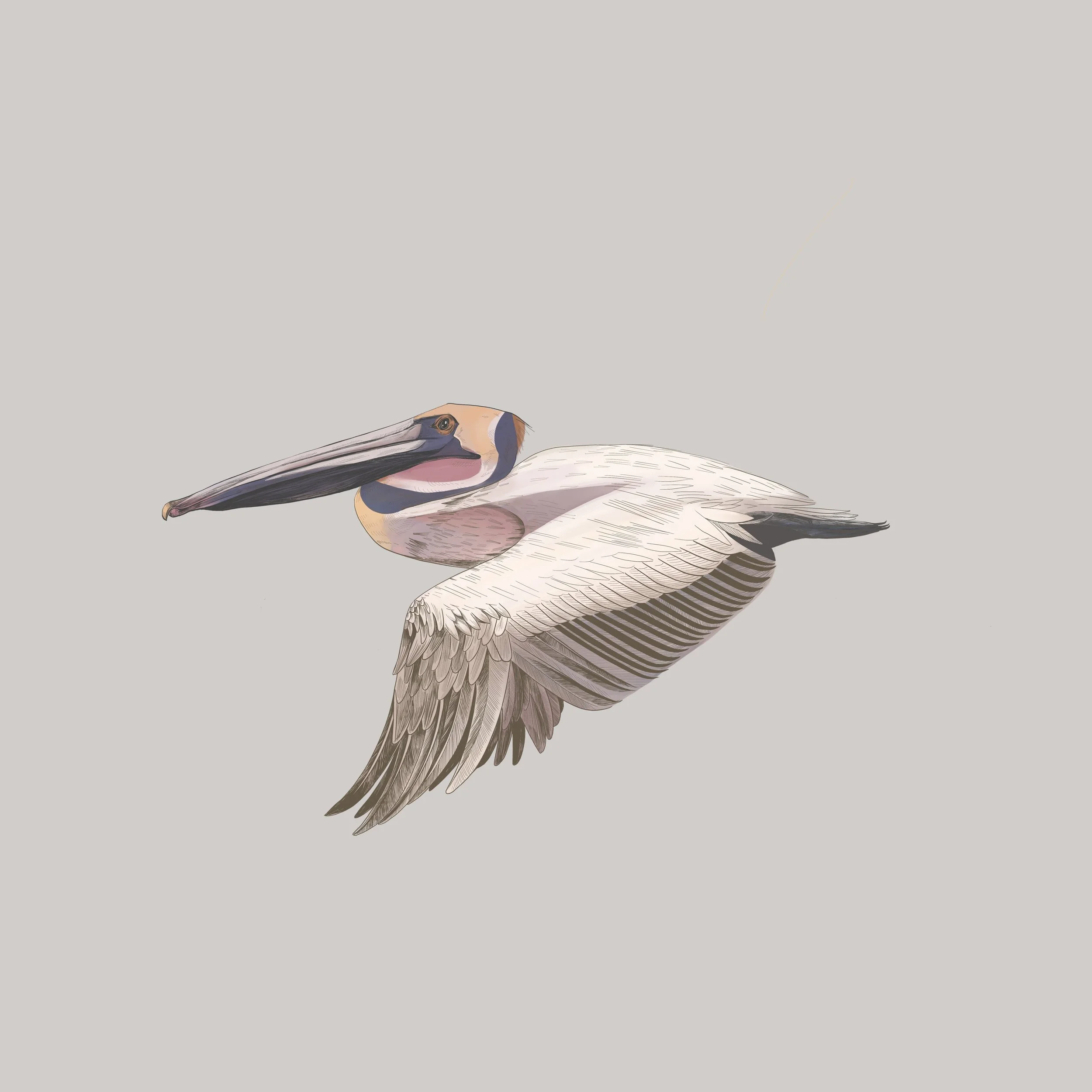
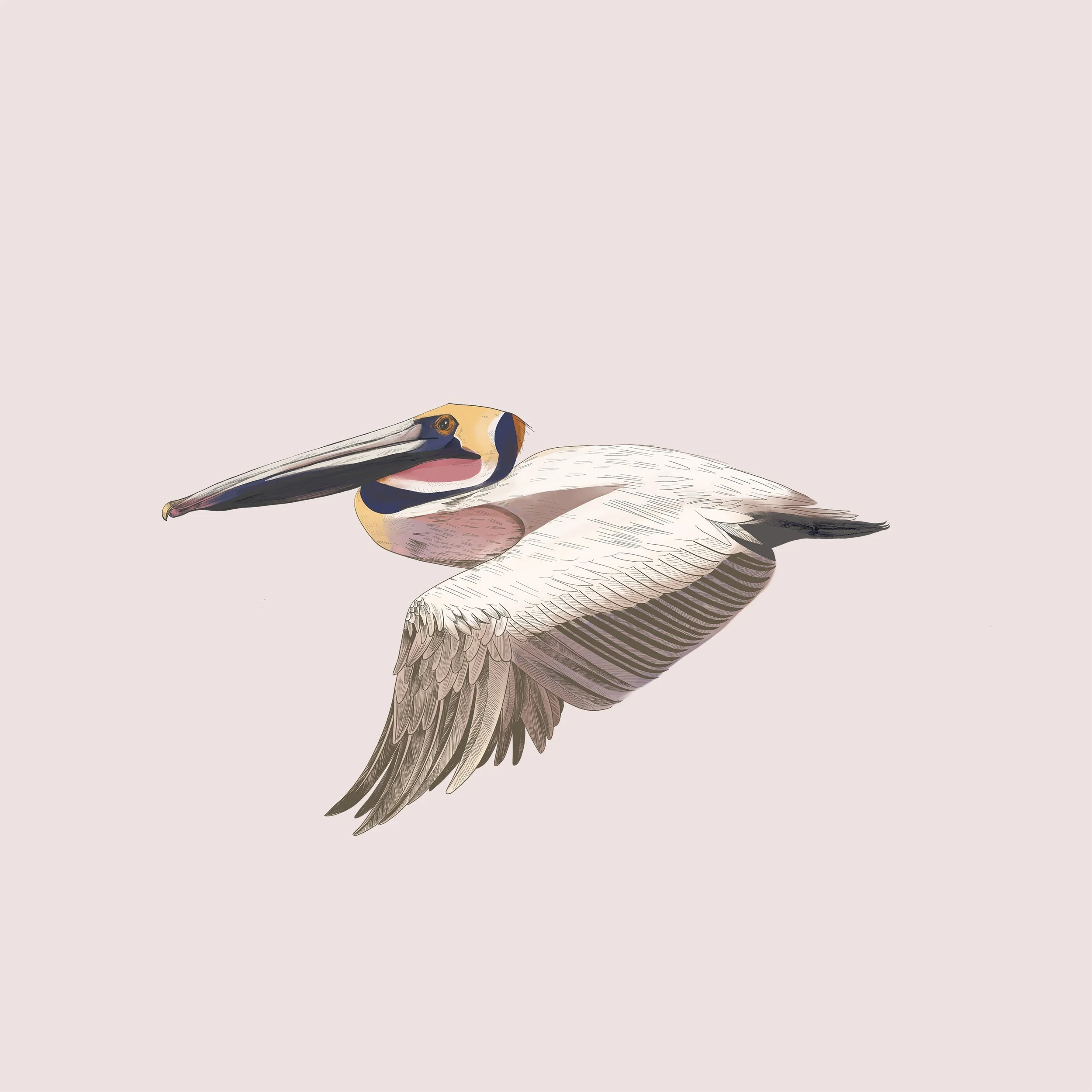
As Kale Tree® looks to nature that inspires us, the California Brown Pelican strongly represents what we find so remarkable about California's nature and wildlife. Our love for the ocean, birds, and the unique qualities of Southern California's environment is reflected in the Pelican. Because its connection to Southern California is particularly tied to its breeding colonies, the Pelican in our textiles and wallcoverings wears the bright seasonal colors the California Brown Pelican dons during breeding season.
What are the colors of a California Brown Pelican?
While most of the year, the Pelican typically has a primarily brown body, during mating season, "the distal end of the bill turns reddish, the proximal end of the throat pouch brightens to a poppy-red, the iris turns a yellowish white to light blue, and a white stripe runs down the pouch side of the neck". These bright, beautiful color changes celebrate the unique characteristics of the Pelican that drew us to the bird, as well as the calm and wonder it inspires.

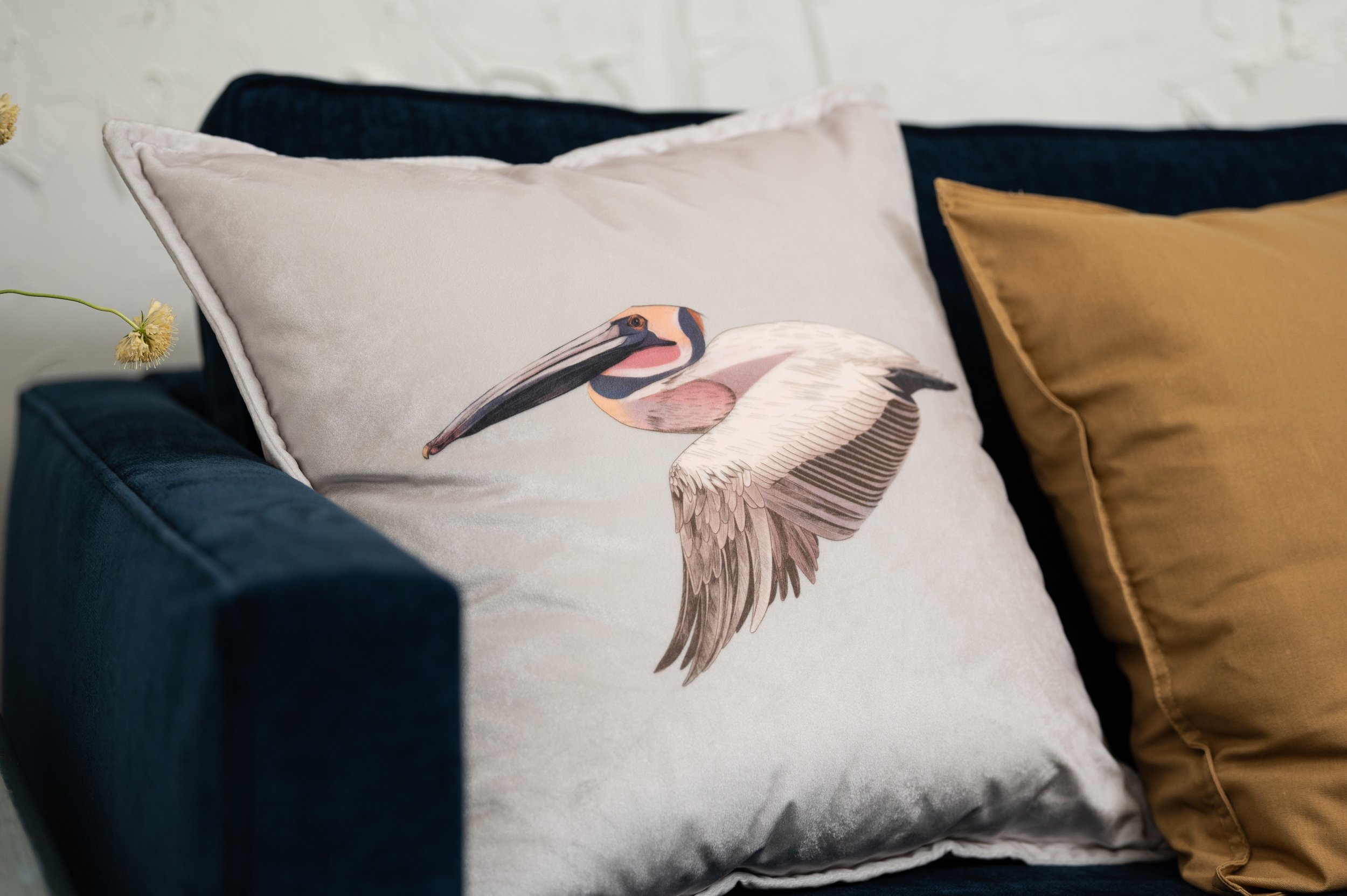
The Pelican art is featured on wallcoverings, Belgian linen, and velvet textiles, reflecting the sense of comfort and peace of being beachside and the exceptional nature of California.
Should I use linen or velvet for pillows, furniture, and draperies?
Kale Tree's Belgian linen and velvet textiles both make excellent options for pillows, upholstery, and draperies. Linen can often contribute to a lighter, more traditional coastal aesthetic. With draperies, linen can also let in more light than velvet, while velvet may be preferable for temperature control. Many may also enjoy the sumptuous tactile nature of velvet for pillows and upholstery.
What are the best ways to decorate with bird motifs?
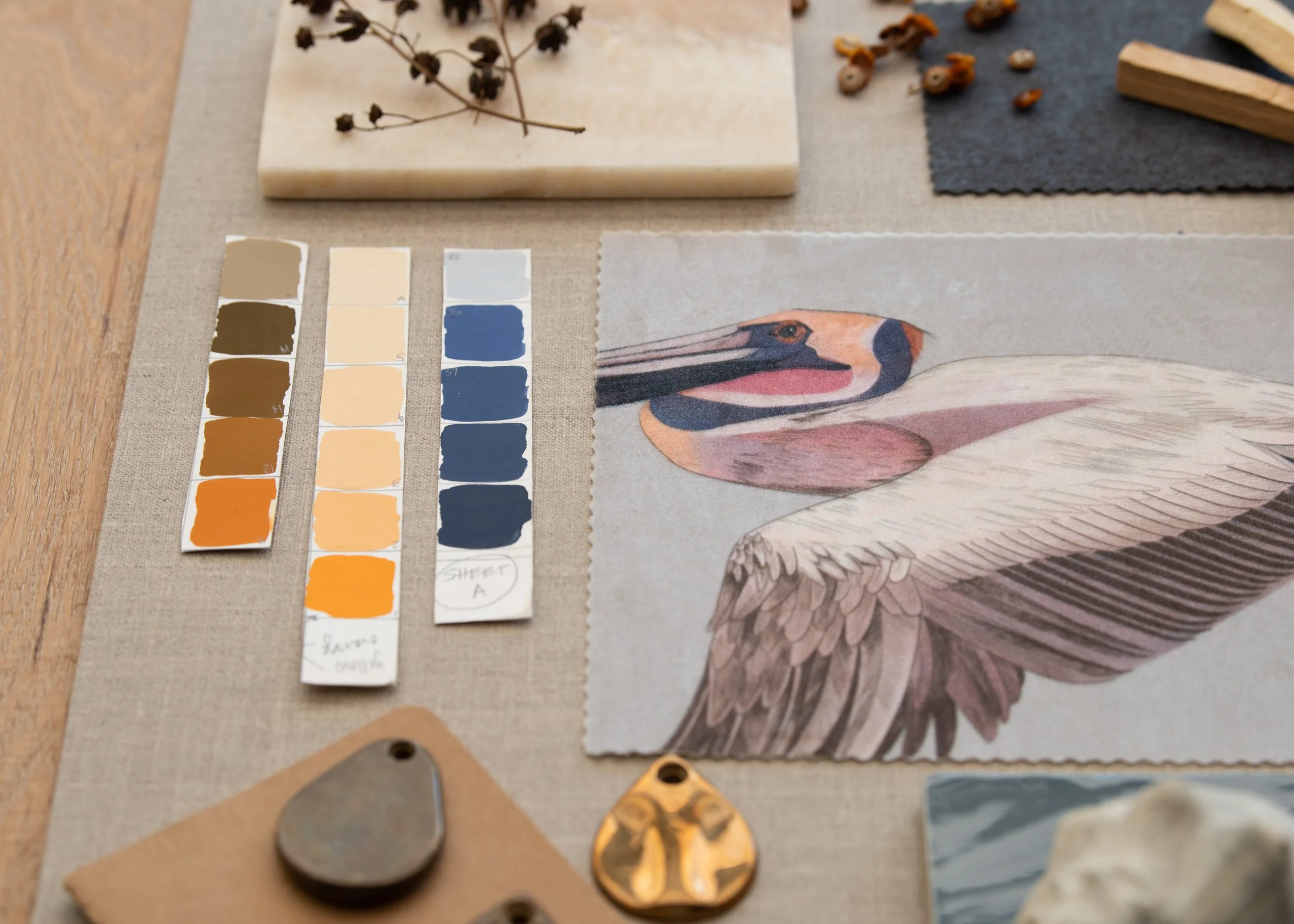
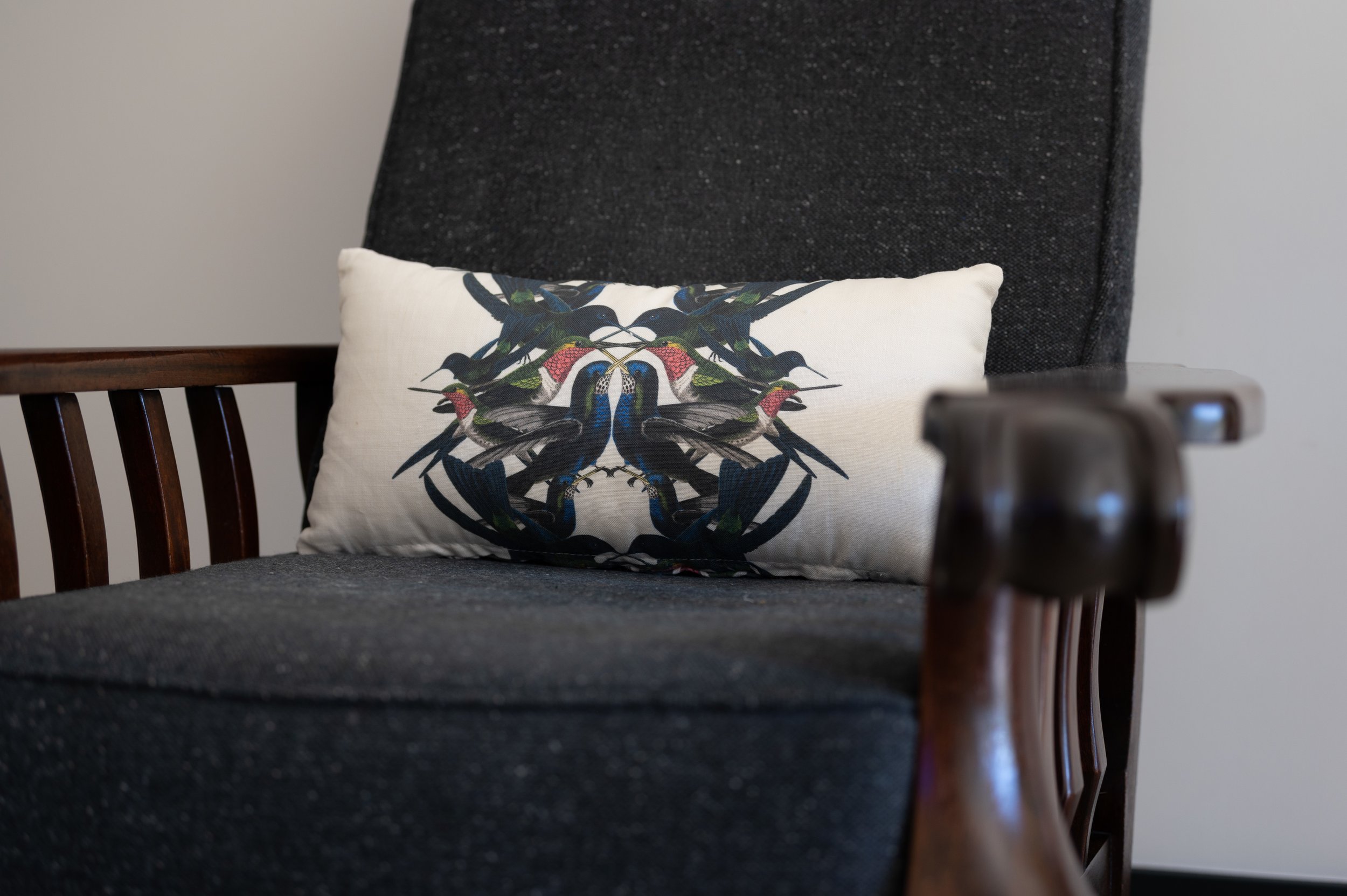
Bird motifs are excellent for creating visual interest and carrying or introducing color throughout a room. Bird motifs are wonderful when used on throw pillows or bedding, or to create a more dramatic statement on an accent chair or draperies. When used in a larger pattern, like wallcoverings, they can create movement that adds dynamism to a space. In the case of the pelican print, the larger swaths of pattern have a transportive quality, evoking the sight of a pod of pelicans flying above the ocean.
How can I decorate with coastal decor in the winter?
Coastal decor doesn't need to be limited to the summer months. Using softer, more neutral shades of beige or grey can take coastal themes beyond traditional beachy palettes and into more year-round aesthetics. Unexpected fabrics like velvet can add warmth and depth, making more coastal themes appropriate for year-round decor.
https://www.nps.gov/places/000/california-brown-pelican.htm
https://www.aquariumofpacific.org/reportcard/info/california_brown_pelican
Kale Tree Holiday Gift Guide
Give the gift of Biophilic design this holiday season with some of our favorite nature-inspired goods from Kale Tree.

Matilija Poppy Textile - Natural
The Matilija Poppy, a beautiful and unique California native wildflower, inspires this hand-drawn textile design from Kale Tree. This textile is printed on luxurious Belgian linen, ready to be transformed into an array of customized home goods like pillows, drapery, and bedding that will bring the joy of a Californian super bloom into the home of our gardening enthusiast friends and family.

The hand-drawn pattern of the Kale Tree Tree Moth rug is inspired by moths fluttering at dusk. This pattern seeks to add a quiet beauty to any room, a perfect gift for those who appreciate the subtle beauty of nature's pollinators. Each rug is handmade to order in either Vegan Bamboo Silk or 100% New Zealand Wool for a luxuriously soft feel underfoot. Available in 5 x 8, 8 x 10, or 9 x 12 to suit any home size.

Ginko Indoor Outdoor Light Fixture
The Ginko leaf is a symbol of peace, healing, and longevity that often appeared in the designs of the Art Nouveau and the Arts and Crafts movement. This beautiful Ginkgo indoor/outdoor light fixture made of cast bronze Ginko leaves cradling a milk glass globe is sure to be a treasured gift for those who appreciate the beauty of art and nature.

Give the gift of nature-inspired healing spaces with this eco-friendly wallcovering from Kale Tree, featuring a hand-drawn pattern inspired by Mallow blossoms. Commonly called Abutilon or Flowering Maple, this woody shrub is best loved for its delicate drooping blossoms. Available in 3 colorways (Midnight Forest, Evening Mauve, and Dusty Dawn), we love the soothing color of Dusty Dawn as it evokes the calm of dusk. This wallcovering is also PVC and VOC free, contributing to a healthy home environment.

The Cholla Tote is an excellent option for those looking for something special to include in this year's holiday stocking. This design is based on a pen and ink illustration of a Cholla cactus, native to northern Mexico and the Southwestern United States. Hand-printed on 100% certified organic cotton, this tote makes a beautiful yet practical gift.
This selection of bespoke nature-inspired goods helps connect our home interiors with the beauty and peace of the natural world. Give the gift of a mindful home this holiday season, exclusively available through the Kale Tree online store.
Sarah Barnard, WELL AP + LEED AP, is a leading designer of personalized, sustainable spaces that support mental, physical, and emotional wellbeing. She creates highly personalized, restorative spaces that are deeply connected to art and the preservation of the environment. An advocate for consciousness, inclusivity, and compassion in the creative process, Sarah has appeared in Architectural Digest, Elle Décor, Vogue, HGTV, and many other publications. In 2017 Sarah was honored as a “Ones to Watch” Scholar by the American Society of Interior Designers (ASID).
California Native Gardening: Rewilding Los Angeles Landscaping
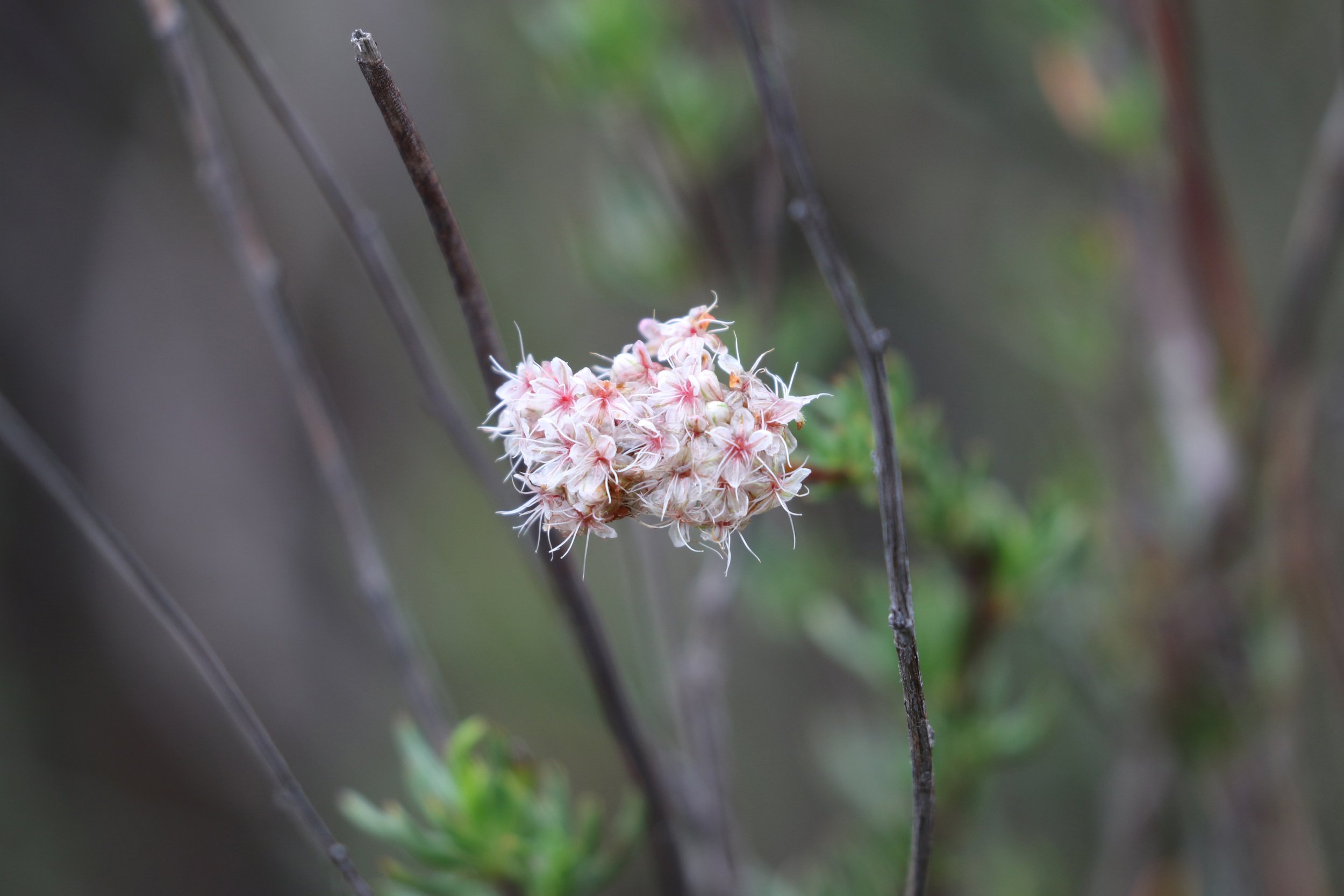
California Buckwheat (eriogonum fasciculatum)
With such an array of beautiful and unique plant life, it’s no wonder more and more people are opting to replace their lawns with California native gardens. The state of California is a biodiversity hotspot, with 61% of its plant life found nowhere else in the world. (1) There are many benefits to rewilding our gardens with California native plants. They can reduce our environmental footprint by using less water and creating habitats for local insects and animals, enriching the biodiversity of our local neighborhoods. We also have the pleasure of experiencing the emotional and mental health benefits that result from nurturing this environment and joyfully watching wildlife thrive amongst the beautiful wildflower blooms.

Coulter's Matilija Poppy (Romneya coulteri)
As a Certified California Naturalist, Sarah enjoys expanding her knowledge of Californian native flora and fauna. She recently completed the California Native Plant Landscaper Certificate Program offered by the Theodore Payne Foundation. Developed in partnership with The California Native Plant Society, LADWP, and The US Green Building Council, Los Angeles, this course covers the steps involved in planting and maintaining a California native landscape, such as identifying soil type, choosing plant communities, irrigation, and pruning.

Palmer's Indian Mallow (Abutilon palmeri)
The Theodore Payne Foundation's best practices suggest developing a California native garden as a 4-year process. Although at first, a California native garden will likely require the same amount of water (or possibly more) than a lawn, a California native garden is a long-term investment towards drought tolerance and increasing local biodiversity.

Yerba Santa (Genus Eriodictyon)
Year one involves the initial steps of creating a plant list, mulching, evaluating the runoff potential of a site, sowing wildflowers, and staking young plants. Year two is more about maintaining the garden by raking, pruning, watering, re-mulching, sowing wildflower seeds, weeding, and removing struggling plants. Year three involves seasonal maintenance such as watering, pruning overgrown plants, weeding, and replanting. And year four involves pruning with long-term shaping in mind, weeding, replanting, and watering.
An important course component involves identifying what plants best suit the site based on soil qualities and plant communities. There are generally three soil types, sandy, loamy, and clay which vary in their infiltration rate, water-holding capacity, nutrient-holding capacity, and aeration. Plant communities are groups of plants that typically grow together in natural environments.
California Native gardens usually derive from the following plant communities:

Woolly Bluecurls (Trichostema lanatum)
Coastal Sage Scrub are plants that tend to grow low to the ground; they include many aromatic plants such as Artemisia, Buckwheat, Salvias, and Matilija Poppy as well as Deerweed.

Miner’s Lettuce (Claytonia perfoliata)
Chaparral is thick, dense growth that contains a lot of diversity and tends to burn easily. This group includes Chamise, Scrub Oak, Buckwheat, Matilija Poppy, and Toyon.
Desert is a very diverse community of plants that exist at various elevations, such as Cacti, Joshua trees, Agave, Abutilon-Palmeri (Mallow), and Saltbush.

Cholla Cactus (Genus Clindropuntia)
Riparian is a diverse community of plant species that usually exist streamside, creating vital habitat for California wildlife; this group includes plants such as Jancus, Carex, and Ferns.

California Buckeye (Aesculus californica)
Pruning is commonplace in any garden to shape and control the size of plants, stimulate growth, and improve overall plant health. Folks have very different opinions about pruning a California native garden; some believe the landscape should grow wild and natural, while others regularly prune to control shape and growth.
Tip pinching is often performed in California native gardens; this involves pinching new growth off the tips of certain plants or right after flowering to stimulate fuller growth. For example, Ceanothus is a plant that benefits from tip pinching after flowering.

Bladderpod (Peritoma arborea)
Deadheading is the practice of removing dead flowers from plants before they go to seed, this can improve the appearance of plants and prolong the flowering season for some. Deadheading is sometimes discouraged in California native gardens as birds like to feed on seeds. Allowing plants to go to seed creates a natural food source, plus we get the pleasure of watching wildlife interact with the native plants in our yard. Toyon is an excellent example of this; its flowers bring berries which become food for Robins, Waxwings, Thrushes, and other visiting birds.

California Poppy (Eschscholzia californica)
Embracing a California native garden is a rewarding transformation with many benefits, including eventual drought tolerance, reduced maintenance, and the generation of natural habitat that increases the biodiversity in our neighborhoods. There is also the added benefit of joy we experience through the mindful activity of watching birds, insects, and animals live and thrive in the ecosystem that we have created within our yards.

Works Cited
(1) “Explore the Biodiversity Hotspots.” CEPF, https://www.cepf.net/our-work/biodiversity-hotspots.
(2) Theodore Payne Foundation. “California Native Plant Landscaper Certification.”
Sarah Barnard is a WELL and LEED accredited designer and creator of environments that support mental, physical and emotional wellbeing. She creates highly personalized, restorative spaces that are deeply connected to art and the preservation of the environment. An advocate for consciousness, inclusivity, and compassion in the creative process, Sarah has appeared in Architectural Digest, Elle Décor, Vogue, HGTV and many other publications. In 2017 Sarah was recognized as a "Ones to Watch" Scholar by the American Society of Interior Designers (ASID).